
Engineering UPF alumni Diego Rodríguez, co-founder of Krea, inaugurates the 2025-2026 academic year
Engineering UPF alumni Diego Rodríguez, co-founder of Krea, inaugurates the 2025-2026 academic year
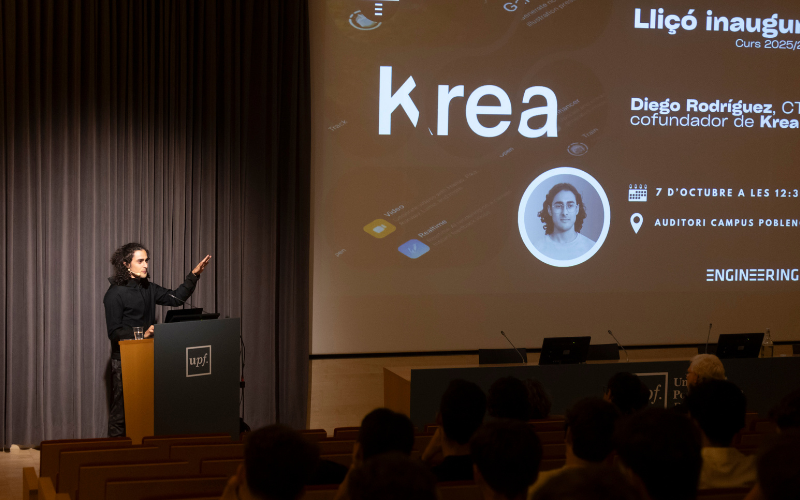
Engineering UPF alumni Diego Rodríguez, co-founder of Krea, has inaugurated the 2025-2026 academic year. During his talk, Rodríguez reflected on the present and future challenges facing the human condition in light of the effects of artificial intelligence on our daily lives and in the workplace. Moving away from a technical lecture, he invited students to think and look at the world with greater awareness, sharing personal habits and reflections he considers essential for personal and professional growth.
“The key is learning to pay attention,” he stated, referencing David Foster Wallace’s fable This Is Water. With this metaphor, he emphasized how we often fail to notice the most obvious realities, and that staying attentive and alive during adulthood can completely transform the way we create, innovate, and, above all, become more human.
Rodríguez also spoke about his own journey. Together with Víctor Pérez, co-founder of Krea and also a Engineering UPF alumni, he started the project during his time at Cornell University in New York, thanks to a scholarship from the “la Caixa” Foundation.
From that experience, the idea for Krea was born—one of the most prominent emerging companies in generative artificial intelligence, headquartered in San Francisco, focused on developing tools that facilitate visual creativity through AI. Currently, Krea, has raised $83 million in multiple funding rounds and is valued at around €500 million.
According to Rodríguez, the secret to Krea’s success was questioning what seemed obvious: “We saw some technologies competing separately, but we realized they could collaborate. It was obvious, but no one had paid enough attention,” he explained.
During the Q&A session, Rodríguez highlighted that the most necessary skills for future students are knowledge of history, understanding how technology works, and reclaiming the human values that, in his view, “seem to have faded in recent times.” He also stressed the importance of “not going with factory settings”: questioning yourself, doubting, and making mistakes are essential parts of learning.
After the inaugural lecture, the speaker participated in the “A Coffee with Diego Rodríguez” activity, a smaller and more intimate space where about thirty students could share doubts, concerns, and chat with him in a more open manner.
