
The First Valence Asymmetries Conference took place on 19 & 20 March 2026 in Sala Nau, at UPF Poblenou. It was a tremendous success!
The First Valence Asymmetries Conference took place on 19 & 20 March 2026 in Sala Nau, at UPF Poblenou. It was a tremendous success!
The First Valence Asymmetries Conference took place on 19 & 20 March 2026 in Sala Nau, at UPF Poblenou. It was a tremendous success!
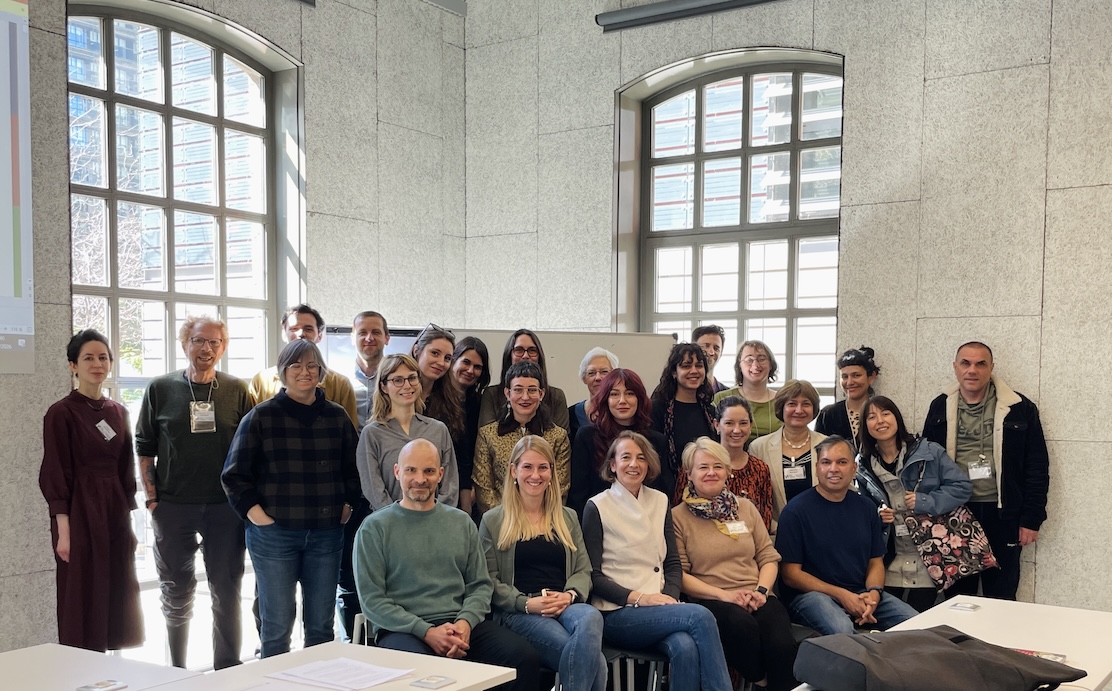
The First VALENCE ASYMMETRIES conference took place with great success on March 19th-20th 2026 in Sala Nau, at the UPF Poblenou Campus. It was preceded by a one-day Pre-conference workshop.
This interdisciplinary event was an unprecedented opportunity to discuss topics which are central to the project, including the role of valence asymmetries in perception, emotion, morality, language, and communication.
On Day 1, after a short introduction by the project PI Isidora Stojanovic, the first keynote speaker, Hans Alves, from Ruhr University Bochum, gave the talk "Valence Asymmetries - A Perspective From Cognitive Psychology", in which he reviewed empirical research that he conducted with his colleagues over the past decade regarding the structural and objective differences between positive and negative information.


Prof. Alves focused on how these differences influence psychological phenomena, such as typical biases. While positive information occurs more frequently, negative information is more diverse. As a result, negative information is more novel, attention-grabbing, interesting, impactful, and memorable than positive information. He then explained how in the domain of social perception, negative information is also more diagnostic of group differences, and therefore, negative attributes often become stereotypes.
The second talk, "Locating value in moral progress: Valence asymmetries in folk intuitions", was by Federico Bina (University of Genova) in which he presented joint work with his Genovese colleague Filippo Domaneschi, devoted to the question of what makes social changes progressive or regressive. Moral progress has attracted significant attention in philosophy and empirical research, but an underexplored issue concerns what makes certain social or individual changes morally progressive or regressive, a.k.a. as the “location issue”: evaluative claims about progress entail judgments that some kinds of change are valuable, raising the question of where value is located. Bina and Domaneschi's work offers the first empirical exploration of the location issue. He presented their recently conducted experimental studies, the results of which gave rise to a very vivid discussion.
After the lunch break, for which all participants were cordially invited to a buffet lunch offered by the project, the conference resumed with the talk "On the asymmetries in the morality of procreation, or why moral duties require complaints but not debts of gratitude", by Ida Miczke, from the University of Saint Andrews. The procreation asymmetry refers to the intuition that one has a moral obligation to refrain from procreating in case one knows that the child would life the life of unbearable suffering, but no obligation to procreate in case one knows that the child would live a happy life.

Dr. Miczke proposed a novel account of the puzzle that grounds it in a deeper asymmetry in our moral reasoning, namely, one between violations vs. fulfilment of duties. The proposal elicited vivid discussion.
The next talk, "Valence Asymmetries in Political Discourse: Exploring Language, Morality, and Emotions in War Media Coverage under Restrictive Regimes", by Alexey Tymbay, analyzed pragmatic implicatures in a very interesting and timely corpus constituted from various pro- and anti-Kremlin channels covering the Russia-Ukraine war. This talk gave us all the opportunity to consider how research can be practically applied to address real-world issues.
The last talk of Day 1 was by keynote speaker Pascale Willemsen, from Zurich University, and had for title: "More than a reflection: Asymmetries between blame and praise and how to measure them".

Prof. Willemsen's starting point was the observation that while moral responsibility comprises both blameworthy and praiseworthy conduct, philosophical and empirical research has disproportionately focused on the former. She stressed that this focus on negatively-valenced moral phenomena has left our understanding of morality's "positive side" significantly underdeveloped, and presented empirical evidence from ten different studies exploring this asymmetry. Her closing point was that examining specific differences between praise and blame posed a significant methodological challenge, requiring a fundamental shift in how we measure and conceptualize moral responsibility.
Day 2 begun with a talk by keynote speaker Saif M. Mohammad, from National Research Council Canada, who also gave a talk at the pre-conference workshop two days earlier. In his talk, entitled "Computational Affective Science: Understanding How Emotion Shapes the Mind, Body, and World", Dr. Mohammad presented a series of case studies illustrating how affect and emotions are intertwined with the mind (thought and sense-making), the body (health and well-being), and the world we interact with, notably: (1) Worry Words and Words of Warmth: Large-scale lexicons of anxiety and warmth associations for English words; (2) Utterance Emotion Dynamics: Quantifying patterns of emotional change in narratives and tweet streams; and (3) Utterance Emotion Granularity: Using text to measure people’s ability to differentiate emotions, and examining its relationship with mental-health outcomes. The talk was followed by a lunch at the nearby Café Daniel, offered to all participants by the project, during which they could discuss various project-related topics in a friendy and relaxed atmosphere.
The next talk, by Lelia Glass, from the Georgia Institute of Technology, entitled "Sentiment-linked quantification among adjectives", started with the following puzzle: how is it that when we say "The cups are clean" we typically means that all of the cups are clean, whereas we are warranted to say "The cups are dirty" even if only some of the cups are dirty?

Prof. Glass linked sentiment to quantification using a principle from social psychology: for a composite entity to be good, all its components must be good, while the entity is bad if any component is bad. She further presented results from several experiments that support her account.
The following talk, by Valentina Apresyan, from Darmouth College, entitled "Valence Asymmetries in Moral Emotion Lexicons: English, Russian, and Kazakh in a Parallel 'Gone with the Wind' corpus", delved into how different languages - here, English, Russian and Kazakh, "engineer" moral valence – negative vs. positive and outer-facing vs. inner-regulative – through their lexical systems. She showed that English maintains a relative separation between shame, guilt, conscience, and honor; Russian shifts negative affect onto lexemes conventionally coded as positive; while Kazakh integrates emotion, moral judgment, and social harmony.
The closing talk of the workshop, "Affective senses", was delivered by keynote speaker Frédérique de Vignemont, from the Jean-Nicod Institute in Paris. She started by noting that it is classically assumed that within perception, only taste, olfaction, and some form of touch can be intrinsically affective; vision and audition, on the other hand, can only trigger affective responses, which remain external to the sensory experiences.

Prof. De Vignemont surveyed results from recent experiments on visual processing, and proposed that visual experiences can sometimes be characterized by a distinctive affective attitude. The idea is that one can be visually engaged by positive or negative objects, and this attitude determines the intrinsic (un)pleasantness of the visual experiences. She further explored whether the same attitude of engagement is involved both for positive and negative valence, thereby suggesting that the scope of valence asymmetries maybe be even broader than it has been assumed, reaching all the way down to (visual) perception.
In sum, the First Valence Asymmetries Conference was a great success - one that definitely deserved a toast! To celebrate, and keep exchanging over the exciting topics and proposals presented in the conference, the organizers and some of the speakers and participants enjoyed a glass of wine on the Rambla de Poblenou:

(From left to right: Lelia Glass, Frédérique de Vignemont, Isidora Stojanovic, Michelle Stanković, Morgan Moyer, Poppy Mankowitz, and Maria Francesca Molloy.)
To learn more about the talks, you can access the booklet of abstracts here.