
Smart technologies to show the benefits of plants in educational environments, created by a European project involving UPF

Contra el genocidi i contra la violació dels drets humans, a Gaza i arreu del món

Peace comes when you talk to the person you most hate. And that’s where the courage of a leader comes.
Desmond Tutu (1931-2021), first recipient of an honorary doctorate from UPF
These words, spoken by Desmond Tutu, the first person ever to be awarded an honorary doctorate by UPF, are more applicable today than ever. The UPF condemns, and will always condemn, the use of violence to settle disputes. At UPF, we advocate approaching political or territorial conflicts based on dialogue and respect for all peoples and minorities.
As a university, we also want to show our support to the academic community in countries at war. Universities and scientific institutions are more necessary than ever in these regions. Access to education and the promotion of critical thinking, in the context of strong independent institutions, are the way to ensure the informed debate and reflection that can open the door to new avenues for finding solutions.
At UPF, we are aware of the university community’s concern for the human rights violations we are seeing in the conflicts around us. That is why on this website you will find information about campaigns and actions related to current conflicts, as well as opinion pieces and institutional statements. We also offer a dedicated e-mail address – [email protected] – to contact the university and let us know about your interests and concerns.
Smart technologies to show the benefits of plants in educational environments, created by a European project involving UPF
Smart technologies to show the benefits of plants in educational environments, created by a European project involving UPF
The European research project TEASPILS, which involves UPF’s TIDE research group, has investigated over the last three years how to take advantage of so-called Internet of Things to exchange real-time data on the impact of plants in learning environments and thus raise awareness among the educational community of their benefits. The project has been driven by a consortium of six European centres, coordinated by the UPM.
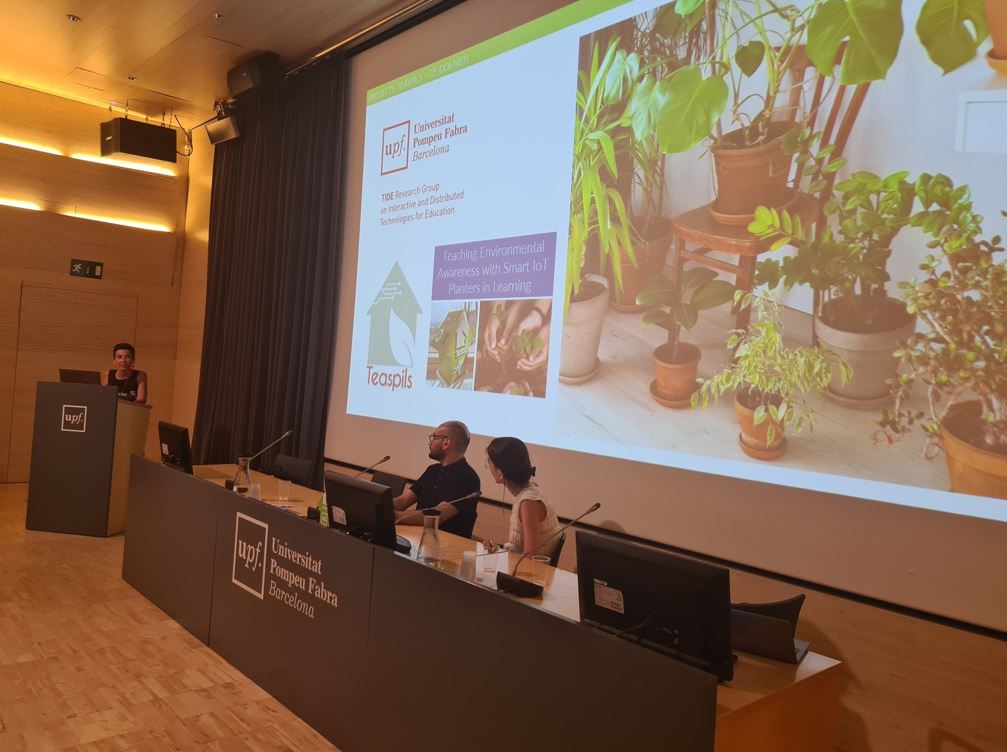
Plants have many positive effects on mental health, well-being and the air quality of indoor spaces, but these benefits are not sufficiently taken into account in educational settings. In this context, the European research project TEASPILS has investigated how to take advantage of technologies, and specifically so-called Internet of Things, to raise awareness among the educational community of the benefits that installing plants in learning environments such as classrooms, study rooms, offices or libraries can have. UPF is participating in the European consortium that is driving the project, coordinated by the Polytechnic University of Madrid.
The concept of Internet of Things refers to a network of physical objects that incorporate sensors, software and other technologies, which allow them to connect to each other to exchange data over the Internet, without the need for human intervention. In this project, IoT has been used to exchange data on the environmental benefits of plants in education centres, between different technological devices, for example between a smart planter and a mobile.
The ability to visualize in real time data on the impact of plants in schools contributes to raising the awareness of students and teachers
The increasing availability of sensors, networks and cloud services on the Internet facilitates means to analyse plant data in real time and the impact they have on the environment where they are located. Being able to visualize these data from the technological devices of the education centres contributes to raising the environmental awareness of students and teachers.
After three years of research with these goals, the TEASPILS project is coming to an end. To take stock of its results, on 19 and 20 June the UPF Poblenou campus hosted the final meeting of the project, funded by the EU’s Erasmus+ programme and developed by a consortium of six European universities, coordinated by the Polytechnic University of Madrid (UPM). UPF is represented by the TIDE (Interactive & Distributed Technologies for Education) research group of the Department of Information and Communication Technologies.
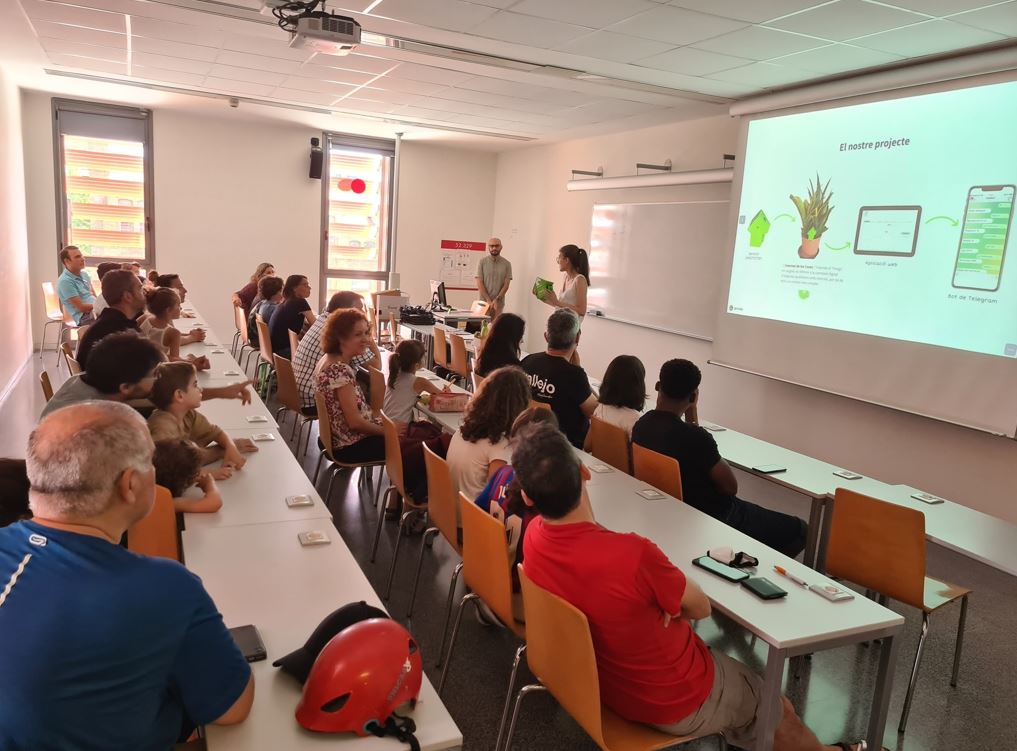
The following centres also belong to the TEASPILS consortium: University College of Teacher Education Vienna (Austria), University College for Agricultural and Environmental Education (Austria), Doukas School (Greece), and Open University of Cyprus (Cyprus).
Davinia Hernández-Leo, head of the UPF TIDE research: “The project has advanced knowledge and technology to facilitate environmental awareness towards plants and greenery and has educated young people and their teachers towards ecological learning spaces”
Davinia Hernández-Leo, head of TIDE at UPF, explains, “The project has advanced knowledge and technology to facilitate environmental awareness regarding plants and greenery and has educated young people and their teachers towards ecological learning spaces, in relation to the sustainable development goals (SDG) of the United Nations Agenda 2030”.
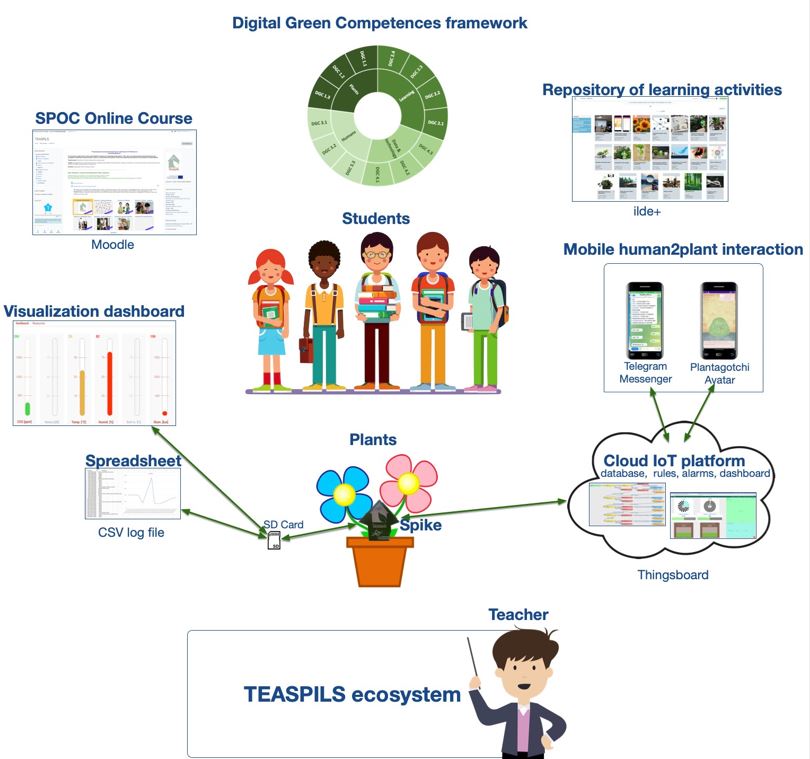
To progress in this direction, the TEASPILS project has developed an open online course for educators and policy makers on how to foster environmental awareness in schools and on how to promote the use of intelligent planters (IoT) to collect environmental data in learning spaces, dashboards to visualize sensory data in mobile and web applications, and a gamification framework, which promotes environmental awareness in a pedagogical way from data provided by the digital sensors.
Bernardo Tabuenca (UFM), project coordinator: “TEASPILS has provided (...) an IoT system, which we call Spike, specifically designed to monitor plants in learning spaces”
In this sense, Bernardo Tabuenca (UPM), coordinator of the project, adds: “TEASPILS has provided a theoretical framework for the design of learning activities to promote environmental awareness, a framework of ‘green’ digital competences, an IoT system, which we call Spike, specifically designed to monitor plants in learning spaces, accompanied by a dashboard and a set of examples for training related to learning activities. Our pilot tests show the potential of IoT technology to teach and promote environmental awareness”.
Pilot tests of the TEASPILS project in schools in Spain, Greece and Austria
The activities of the pilot test have been carried out in real classrooms in Spain, Greece and Austria, corresponding to education centres of different levels, from primary to higher education.
Further information:
Innovative learning activities with the project technology developed (open repository and platform of the teaching community): https://ildeplus.upf.edu/teaspils/
Overview of the project:
Reference article:
Tabuenca, B., Moreno-Sancho, J. L., Arquero-Gallego, J., Greller, W., & Hernández-Leo, D. (2023). Generating an environmental awareness system for learning using IoT technology. Internet of Things, 22, 100756. https://doi.org/10.1016/j.iot.2023.100756
Multimedia
Categories:
Contact
Related Assets

Catalan government
Catalan development cooperation aims to help prevent and respond to emergency situations. This page explains how you can collaborate on the provision of foreign aid both in general and to specific regions.

European Commission
Through cooperation and assistance programmes, the European Commission offers humanitarian aid and coordinates efforts with other international actors to promote peace and stability in war-torn regions.
Oxfam Intermón
Oxfam Intermón works in 90 countries. They have launched a fundraising campaign, which is more necessary than ever, given the magnitude of today’s wars. The NGO is also sponsoring a campaign to collect signatures to call for a ceasefire in Gaza.

Doctors Without Borders (MSF) is a medical-humanitarian action organization that provides assistance in 70 countries to people threatened by armed conflicts, violence, epidemics or neglected diseases, natural disasters and exclusion from medical care. They have also promoted a campaign to collect signatures to ask for a ceasefire in Gaza.

Red Cross
The Red Cross also provides emergency humanitarian aid in regions in crisis.

Legal Clinic
The UPF Legal Clinic regularly holds talks and roundtables on the protection of human rights in crisis regions.
Libraries Without Borders
The Libraries Without Borders programme, sponsored by the Catalan Development Cooperation Agency (ACCD), offers Catalan public library patrons knowledge and insight into situations of human rights violations and provides resources to take action.

Council for At-Risk Academics
The Council for At-Risk Academics, in partnership with universities and higher education institutions, provides urgently-needed help to academics in immediate danger, those forced into exile, and many who choose to work on in their home countries despite serious risks.