EUTOPIA is Awarded New Funding in the Second Call for European Universities

Contra el genocidi i contra la violació dels drets humans, a Gaza i arreu del món

Peace comes when you talk to the person you most hate. And that’s where the courage of a leader comes.
Desmond Tutu (1931-2021), first recipient of an honorary doctorate from UPF
These words, spoken by Desmond Tutu, the first person ever to be awarded an honorary doctorate by UPF, are more applicable today than ever. The UPF condemns, and will always condemn, the use of violence to settle disputes. At UPF, we advocate approaching political or territorial conflicts based on dialogue and respect for all peoples and minorities.
As a university, we also want to show our support to the academic community in countries at war. Universities and scientific institutions are more necessary than ever in these regions. Access to education and the promotion of critical thinking, in the context of strong independent institutions, are the way to ensure the informed debate and reflection that can open the door to new avenues for finding solutions.
At UPF, we are aware of the university community’s concern for the human rights violations we are seeing in the conflicts around us. That is why on this website you will find information about campaigns and actions related to current conflicts, as well as opinion pieces and institutional statements. We also offer a dedicated e-mail address – [email protected] – to contact the university and let us know about your interests and concerns.
EUTOPIA is Awarded New Funding in the Second Call for European Universities
After being part of the 2019 first wave of 17 alliances awarded Erasmus+ financing for the pilot phase of the European Universities Initiative, EUTOPIA is again among the most promising consortia chosen to structure a role model for the future European Higher Education Area.
Today the European Commission has announced the results of the secondforall of funding for the European University Alliances. With an ambitious project titled EUTOPIA MORE, we are proud to be among the first consortia granted with EC funding for this second phase, approximately EUR 14.4 million.
We take it as a sign that our alliance has shown effectiveness in its actions to complete a student-centred European University model that boosts academic excellence and social inclusion. We believe in a collaborative European Higher Education ecosystem that fosters the transformation of education, research and innovation while enabling inclusiveness and substantial partnerships with our local stakeholders. The EUTOPIA alliance is ready to embark upon this second phase, becoming shortly a legal entity laying the foundations of a ten-year partnership.
Our pilot EUTOPIA2050 project (2019-2022) rested on the conviction that today’s challenges call for a transformation of universities through collaboration, which implies re-thinking both the skills that universities need to provide to students and staff, and the way that research can achieve high impact, within academia and beyond. This conviction has been reinforced by the new developments: the COVID-19 pandemic, which catalysed the digital functioning of universities; the growing awareness of the issues related to climate change, which require a shift in social models and individual behaviours; or the tragic war in Europe’s neighbourhood, which demonstrates the continuous need to defend European values. Such large-scale challenges can only be addressed by channelling interdisciplinary skills and operating at an international level. Furthermore, knowledge is becoming ever more complex and subject to change, making a life-long learning perspective absolutely necessary. We firmly believe that solutions to contemporary challenges cannot be engineered solely from the top but be built from the bottom-up, in a flexible fashion, relying on the distributed expertise of various communities.
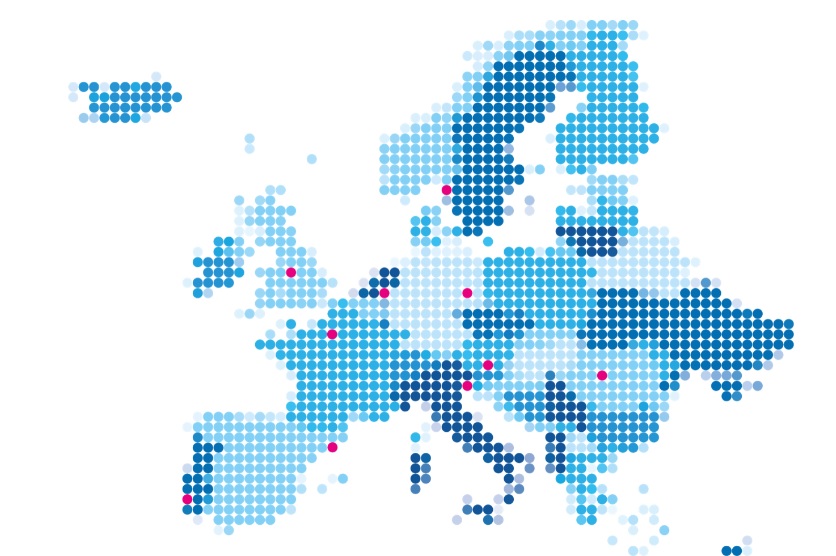
The EUTOPIA European University alliance brings ten European universities aiming to become by 2025 an open, multicultural, confederated operation of connected campuses.
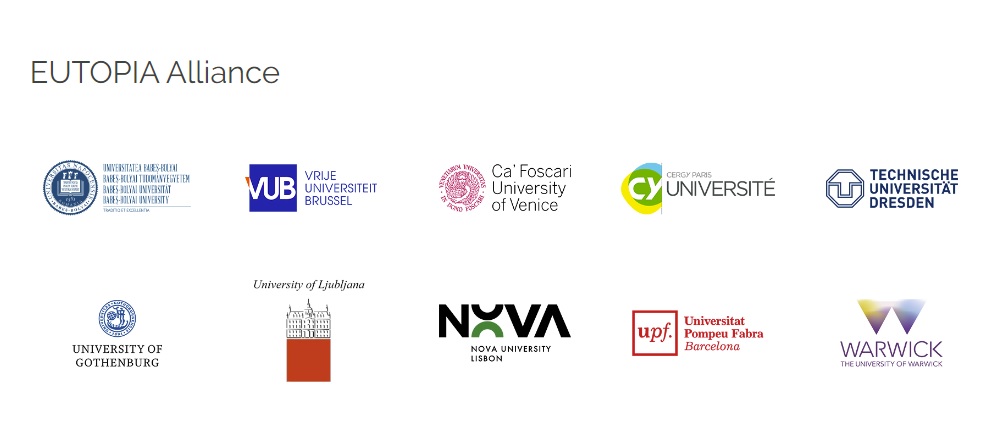
The partner universities are:
- Babeș-Bolyai University, Cluj-Napoca (Romania)
- Vrije Universiteit Brussel (Belgium)
- Ca’ Foscari University of Venice (Italy)
- CY Cergy Paris University (France)
- Technische Universität Dresden Germany)
- University of Gothenburg (Sweden)
- University of Ljubljana (Slovenia)
- NOVA University Lisbon (Portugal)
- Pompeu Fabra University-Barcelona (Spain)
- University of Warwick (United Kingdom)
European Universities are transnational groups of higher education institutions from across the EU. They ensure the quality, inclusion, and innovation of European Higher Education with the financial allowance from Erasmus+ and Horizon 2020 programmes. This initiative is directed to deepen institutional cooperation between higher education institutions, making it systemic, structural, and sustainable, fostering researchers, staff, and students’ mobility. European Universities include institutions ranging from applied sciences, technical universities and film and media art schools to comprehensive and research-intensive universities.
Multimedia
SDG - Sustainable Development Goals:
Contact
Related Assets

Catalan government
Catalan development cooperation aims to help prevent and respond to emergency situations. This page explains how you can collaborate on the provision of foreign aid both in general and to specific regions.
European Commission
Through cooperation and assistance programmes, the European Commission offers humanitarian aid and coordinates efforts with other international actors to promote peace and stability in war-torn regions.

Oxfam Intermón
Oxfam Intermón works in 90 countries. They have launched a fundraising campaign, which is more necessary than ever, given the magnitude of today’s wars. The NGO is also sponsoring a campaign to collect signatures to call for a ceasefire in Gaza.

Doctors Without Borders (MSF) is a medical-humanitarian action organization that provides assistance in 70 countries to people threatened by armed conflicts, violence, epidemics or neglected diseases, natural disasters and exclusion from medical care. They have also promoted a campaign to collect signatures to ask for a ceasefire in Gaza.
Red Cross
The Red Cross also provides emergency humanitarian aid in regions in crisis.

Legal Clinic
The UPF Legal Clinic regularly holds talks and roundtables on the protection of human rights in crisis regions.
Libraries Without Borders
The Libraries Without Borders programme, sponsored by the Catalan Development Cooperation Agency (ACCD), offers Catalan public library patrons knowledge and insight into situations of human rights violations and provides resources to take action.
Council for At-Risk Academics
The Council for At-Risk Academics, in partnership with universities and higher education institutions, provides urgently-needed help to academics in immediate danger, those forced into exile, and many who choose to work on in their home countries despite serious risks.