
Department | School of Engineering
How to promote European digital sovereignty and alternatives to BigTech?
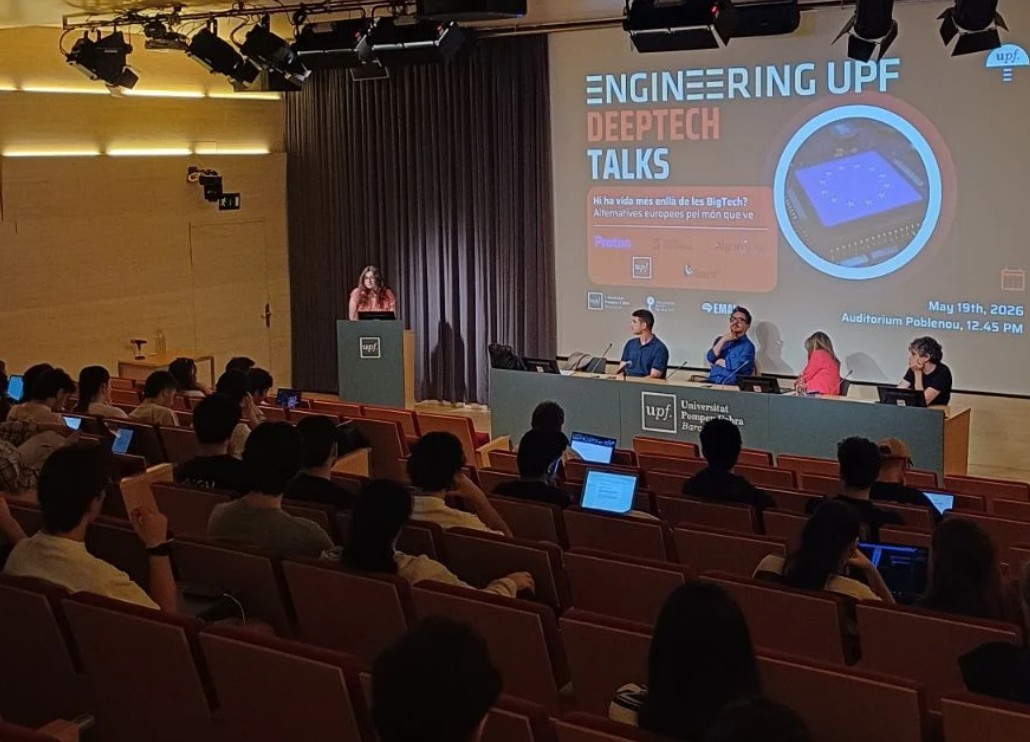
More than fifty people attended a new edition of the DeepTech Talks under the title “Is There Life Beyond Big Tech? European Alternatives for the World Ahead”, an event that brought together experts in technology, digital cooperativism, free software, and technological governance to reflect on the future of European digital infrastructures, technological sovereignty, and the role of citizens in the face of the hegemony of major tech corporations.
The event, held at the Auditorium of UPF’s Poblenou Campus, featured and was moderated by Vanesa Daza, Vice-Rector for Knowledge Transfer at UPF; Jaume Ros, Senior Quality Automation Engineer at Proton and Enginyeria UPF alumnus; Efraín Foglia, member of the Governing Council of Som Connexió and researcher at the UOC; Thais Ruiz de Alda, founder of DigitalFems and member of the Board of Directors of Algorights; and Alberto Larraz, co-founder and CEO of IsardVDI.
During the opening remarks, Vanesa Daza warned about the growing dependence of public universities on digital infrastructures that “we do not control”, describing the situation as a “structural dependency built over many years”. She also stressed that technology “is not neutral” and that designing digital tools also means “creating narratives, governance models, and concentrations of power”.
In this regard, Daza highlighted that Europe has leading-edge research in fields such as post-quantum cryptography, but warned that “having good science and good regulation does not always mean having the effective capacity to deploy technological development”. Nevertheless, she emphasized that Europe’s role in defining global standards is significant and more influential than is often perceived.
Digital alternatives and technological sovereignty
One of the main themes of the debate was the defense of ethical and European digital alternatives to the dominant Big Tech model, which is driven by economic performance and fierce competition.
Jaume Ros presented the case of Proton, the Swiss company with offices in Barcelona behind Proton Mail and Proton Suite, based on zero-knowledge protocols and open-source software. “Our source code can be fully inspected, we are audited, and that creates much safer environments,” he argued. He also noted that Swiss legislation offers particularly strict data protection against potential government interference.
Ros insisted that the change “is more about society and models” than strictly about technology, and defended the idea that everyday decisions also have an impact: “We have the opportunity to decide whether certain companies grow or not, through the choices we make as users or workers.”
From Som Connexió, Efraín Foglia defended cooperativism as a way of placing people at the center of digital services. “Telecommunications services are the sector that has accumulated the highest number of fines in the European Union. We started by focusing on good cooperative members care and service. The governing council, of which I am a member, oversees management and we practice active listening,” he explained. He also pointed out that the challenge is not to seek immediate perfection, but to move towards better models while intelligently managing inherent tensions, acknowledging that “there are always contradictions between wanting to be an ethical project and the capitalist reality”.
Foglia also underlined the importance of political and institutional decisions in driving real change: “Just as there have been outsourcing processes, there can also be insourcing processes. France has done this with Linux,” illustrating how French public institutions have turned the adoption of open-source software into a strategy not only to reduce technological dependence, but also to gain sovereignty and leadership, transforming that reduced dependence into a foundation for projecting their own technological model.
Governance and critical awareness
The governance of artificial intelligence and the social impact of proprietary technologies also occupied a central place in the discussion.
Thais Ruiz de Alda directly questioned current AI models: “Who owns AI? What is the governance model behind this AI?” According to her, many proprietary tools “are not ethical” because they are based on the exploitation of personal data and opaque models. Through Algorights, she explained, they work to help citizens and public administrations understand the criteria they should consider when adopting AI-based technologies, and she defended the need to “continue imagining shared digital infrastructures”.
Ruiz de Alda highlighted specific cases analyzed by the organization, such as RisCanvi, the Catalan prison risk assessment algorithm that influences judicial decisions regarding inmates’ freedom. She stressed that progress in this field is not immediate, but requires intensive technical analysis and exhaustive legal monitoring, as demonstrated by the work of organizations such as Civio, which succeeded in getting Spain’s Supreme Court to rule that the source code of BOSCO — used to determine eligibility for the social energy subsidy — must be made public, creating legal precedent on the right to scrutinize applications used in public decision-making.
At the same time, Alberto Larraz defended the potential of free software and local AI as viable alternatives. “We have been led to believe that Google is the only option, but there are much more powerful alternatives,” he stated. He also warned about the environmental impact of current AI models: “We use tools without knowing how they are consuming the planet. We do not always need to drive a Formula 1 car; sometimes we can take the bus.”
A challenge for the next generation of engineers
The session featured active participation from students, who raised questions about how to act individually within a globalized technological system and what options exist to build real alternatives.
The speakers agreed in rejecting the individualization of responsibility for structural problems. “Placing all the responsibility on individuals when two companies account for 70% of pollution is unfair,” said Foglia. Nevertheless, they also emphasized the importance of collective action and community involvement.
In this sense, Larraz encouraged students to participate in free software communities and projects, arguing that engineers with free software knowledge are more well-rounded, often better paid, and tend to enjoy their work more. Meanwhile, Ruiz de Alda defended the need to create positive “future imaginaries” around technology: “We need to stop creating in order to sell to Silicon Valley and start creating to genuinely change things.”
The event concluded with a reflection from Vanesa Daza on the current moment of transformation: “This is an exciting moment and a paradigm shift. Viewing it from an ethical and global perspective is very important, and events like today’s help us do that.”