
Political Communication, Journalism and Democracy
POLCOM-GRP celebrates the III Seminar on History, Journalism, and Politics
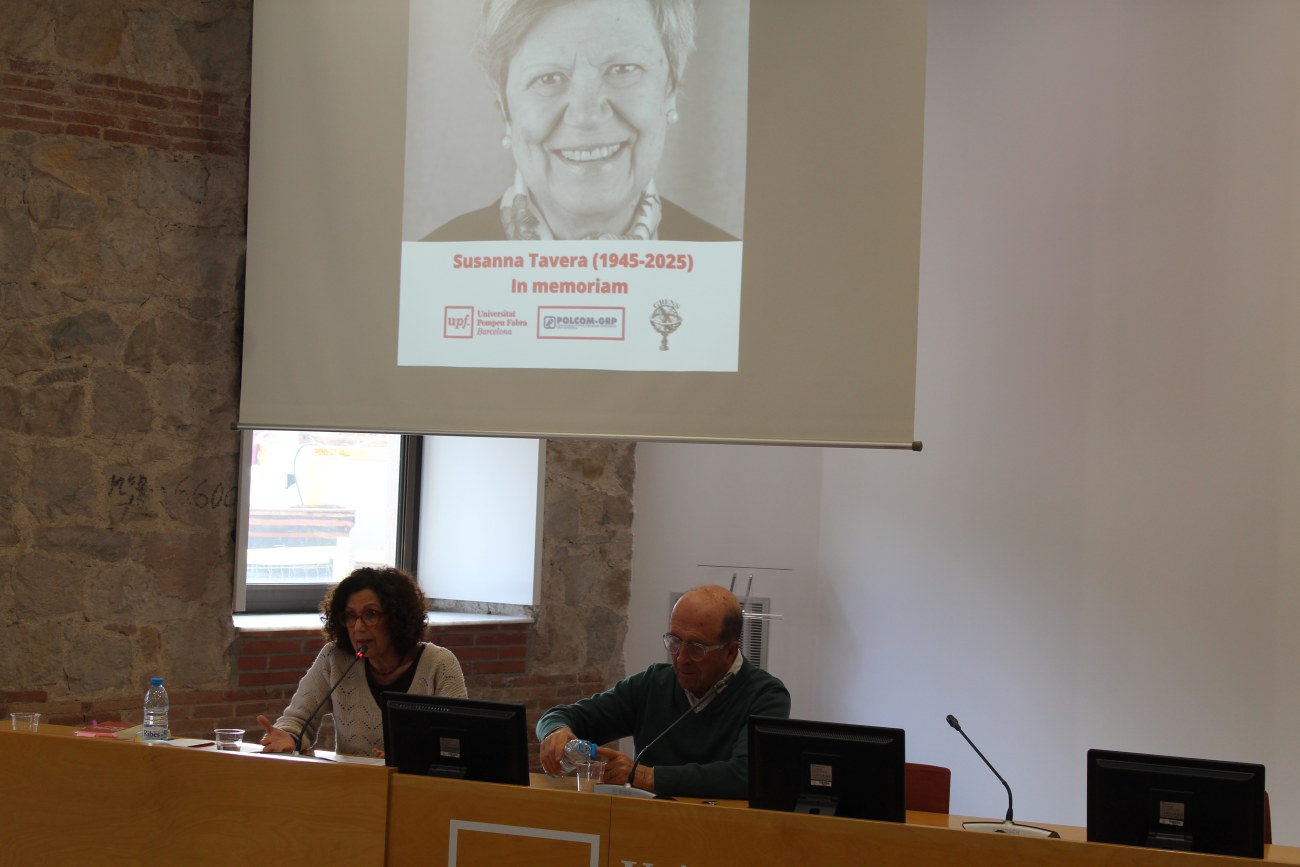
The coordinators of the III Seminar on History, Journalism, and Politics, Jaume Guillamet and Josep Pich, reflected on the career of Susanna Tavera (1945-2025), a historian who made a fundamental contribution to the study of the press, feminism, and anarchism. Her influence on historical research was evident through her participation in research groups and her contribution to the institutionalization of gender studies in Spain. The full recording of the event will be available on the UPF YouTube channel.
Historians and journalism
Historians Gerard Llorens, Víctor López Mirabet, and Pol Dalmau (UPF) reflected on the importance of the press as a historiographical source. The massive digitalization of historical press was highlighted, transforming research by allowing access to a large amount of sources. However, concerns were raised about the risks this involved, such as the possible overrepresentation of certain media (with a specific ideology) at the expense of others that were less digitalized. There was also reflection on the role of the press in the construction of political and social discourses, and the need for a critical approach to avoid biases in interpreting sources. Finally, the discussion focused on how historians should approach the press not only as a source of information but also as a tool for understanding the political and social context of a time. Emphasis was placed on the importance of expanding studies to include local press and diaspora press to provide a more global and diverse perspective.
Women’s voices on the radio
Researcher Elvira Altés (UAB) focused on the Dones a les ones project, which investigated the role of women in radio throughout history. The obstacles women had to overcome in this medium, especially during the Francoist regime when they were relegated to secondary roles, were presented. The importance of recovering and preserving their voices through an audio bank and historical documentation was highlighted. Additionally, Susanna Tavera’s contribution to the dissemination of these studies was emphasized, helping to consolidate research on women and communication. Her interest in radio as a means of spreading knowledge was also mentioned. The seminar concluded that it was essential to continue this historical rescue work to ensure that women were not invisibilized in the media narrative.
Amadeu Hurtado, politics and journalism
Joan Safont (UPF) and Gil Toll discussed the figure of Amadeu Hurtado, a lawyer and press editor with significant influence on 20th-century Catalan politics. His involvement in the newspaper La Publicitat, where he acted as editor and manager, shaping the editorial line of the medium, was highlighted. His relationship with political figures and his role as a bridge between the press and political power was analyzed. Hurtado was a key figure in shaping opinion journalism in Catalonia, supporting the consolidation of a critical and plural public space. The debate also addressed his view of journalism as a tool for influence beyond merely reporting the facts. His ability to build power networks and his participation in debates and intellectual spaces that marked the political and media evolution of the country were highlighted.