Maria Carolina Lopes de Oliveira defends her thesis on digital accountability in the age of short videos
Maria Carolina Lopes de Oliveira defends her thesis on digital accountability in the age of short videos
Maria Carolina Lopes de Oliveira defends her thesis on digital accountability in the age of short videos
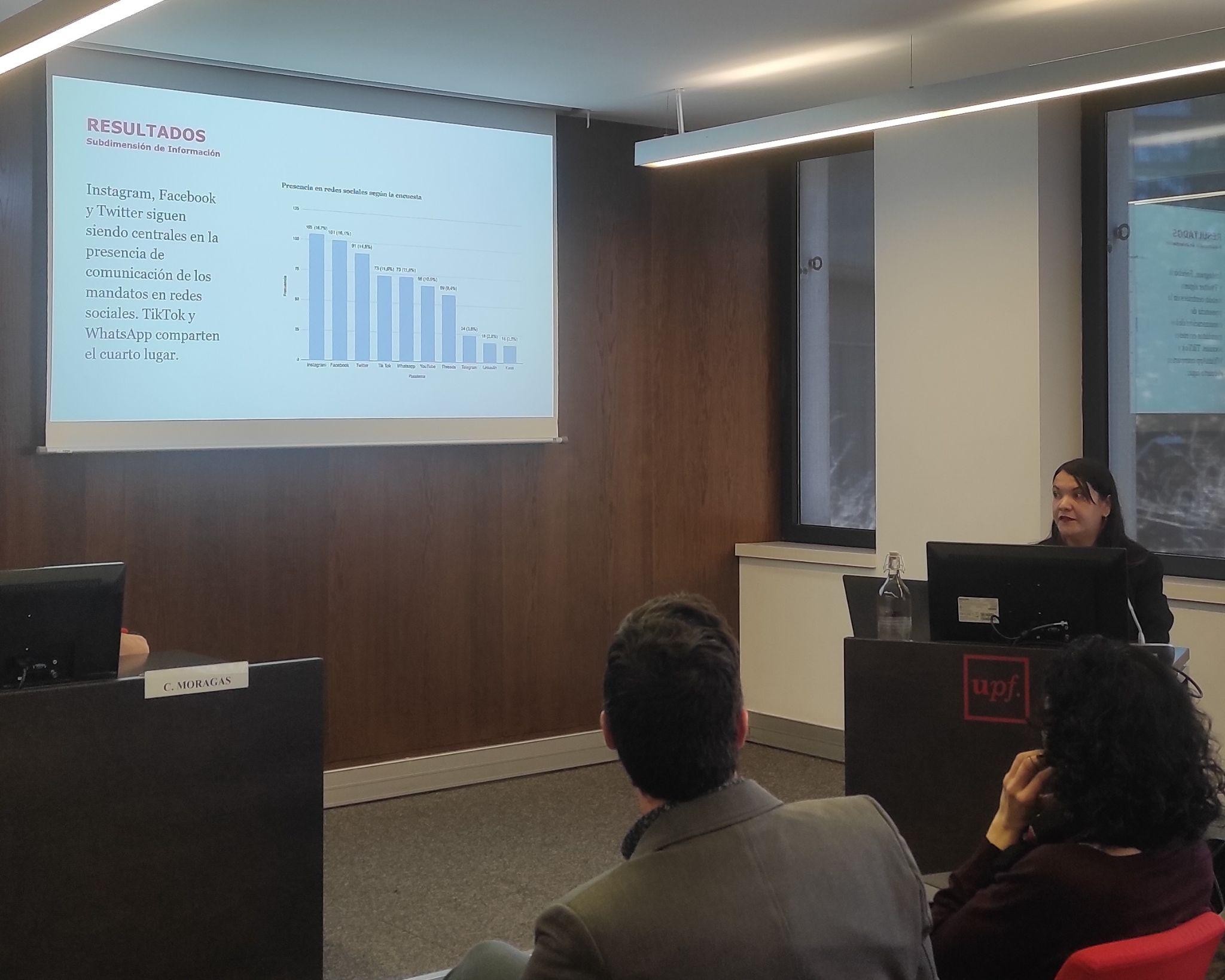
Maria Carolina Lopes de Oliveira, a researcher with the POLCOM-GRP research group, defended her thesis entitled ‘Digital accountability in the era of short videos: an analysis of the social media accounts of Brazilian federal deputies’ on 26 March 2026 at the Poblenou campus of Pompeu Fabra University (UPF). The research, supervised by Dr. Reinald Besalú (UPF) and Dr. Ruth Rodríguez (UPF), was presented in monographic format.
The doctoral thesis combines surveys with content analysis on Instagram and TikTok to answer the question: how does accountability manifest itself in politicians’ communication on social media? Drawing on the literature on political representation and the effects of digital platforms on the public sphere, it acknowledges that the digital environment is reshaping traditional mechanisms of democratic control, particularly affecting the dimensions of information, justification and debate.
The researcher’s personal motivation stems from her professional experience as a journalist in the Chamber of Deputies: “Over the years, I observed how much and how quickly the communication of MPs was changing, particularly following the rise of social media. I felt that this process was also influencing democracy and saw the thesis as a way to study this phenomenon.”
The methodology employed consisted of surveys and content analysis. Firstly, she obtained over 100 survey responses, as participation by the Chamber’s press officers is typically low in studies of this kind. Secondly, the content analysis provided a deeper insight into how politicians use social media during contentious periods and during routine periods. It therefore demonstrates in a significant way how political disputes influence the content published.
With regard to his international experience, Lopes de Oliveira notes that he spent six months at the Brazilian Chamber of Deputies as part of his fieldwork, where he conducted pilot surveys and “observed the work of the advisers at close quarters”, amongst other aspects.
Finally, the results reveal an uneven manifestation of these dimensions: information is the most prevalent and autonomous. Justification, although frequent, is conditioned by delegitimising narratives and strategic orientations, and debate is underutilised by representatives. The characteristics of the digital environment and the algorithmic logics of the platforms influence these dynamics, generating tensions between visibility, communicative effectiveness and accountability.
The panel was chaired by Dr. Carles Pont Sorribes (UPF) and also included Dr. Carlota Moragas Fernández (Rovira i Virgili University) as secretary and D.r Marisa von Bülow (University of Brasília) as a member.