Javier Díaz Noci Participates in the Council of Europe’s Parliamentary Conference on Artificial Intelligence at the British House of Commons
Javier Díaz Noci Participates in the Council of Europe’s Parliamentary Conference on Artificial Intelligence at the British House of Commons
Javier Díaz Noci Participates in the Council of Europe’s Parliamentary Conference on Artificial Intelligence at the British House of Commons
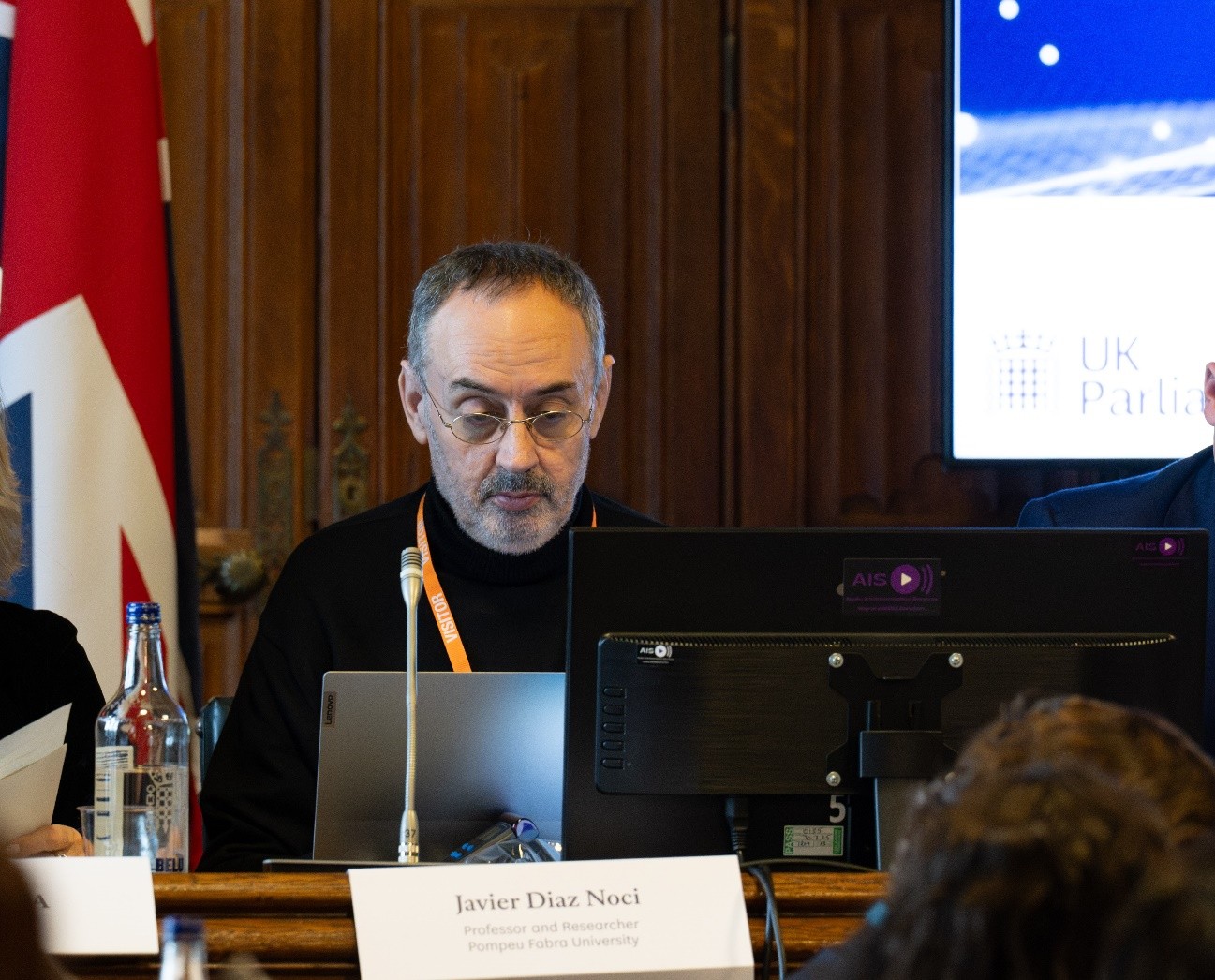
Javier Díaz Noci, a researcher from the Digidoc group, participated in the Parliamentary Conference on Artificial Intelligence, held at the House of Commons (the British Parliament) on December 15 and 16, 2025. The conference, organized by the Parliamentary Assembly of the Council of Europe and the UK Parliament, brought together over thirty specialists in the fields of disinformation, law, communication, and policymaking.
Díaz Noci, who spoke during the roundtable on Artificial Intelligence, Disinformation, and Democracy, addressed the dangers of "those deceptive manifestations, especially deepfakes, backed by the interests of third-party powers—what is known as Foreign Information Manipulation and Interference (FIMI), the greatest danger we face and our primary legal weakness." According to the Digidoc researcher and Professor of Media Law for the Journalism degree at UPF, "it is clearly difficult to determine the authorship of deepfakes, to attribute responsibility and liability for such conduct, and to overcome the territorial limits of laws, even when resorting to international law mechanisms—and other foreign policy measures—which have relative effectiveness." One of the key takeaways from the conference is that "technology is borderless; the law is not."

Source: https://flic.kr/s/aHBqjCv8kH
Furthermore, the symptoms are clear: "The response to disinformation has become more difficult in recent years due to the decline in public trust in the media, news fatigue and avoidance, and the perception that media and institutions are partisan and lack transparency." This is a scenario in which "the majority of people, especially the youth, rely on social networks for information; networks managed by giant corporations outside of Europe for whom money comes first, with little obligation or need to concern themselves with the truth."
Regarding solutions, Díaz Noci advocates for "a combination of tools: fact-checking, administrative measures, and diplomacy in the case of FIMI." Regarding fact-checking, he referenced a recent guide for combating electoral deepfakes by two Honduran newspapers, Heraldo and La Prensa, which proposes reverse image searches, metadata analysis, and network tracking. He also noted that the European Union utilizes the European Fact-Checkers Standard.
The UPF researcher believes that "we must effectively regulate transparency in the production and dissemination of AI-generated content, as well as copyright, because if we do not create the law ourselves, the market will—namely X, Meta, OpenAI, Google, as well as Palantir and the current US administration." In his view, the alternative being proposed is "deregulation, the old motto of laissez-faire, laissez-passer." In response, he proposes "creating or reforming the law, but above all, we need to harmonize it and avoid fragmentation and divide et impera (divide and rule)."