Ernesto Navarro López defends his thesis on journalistic cultures in transnational migration
Ernesto Navarro López defends his thesis on journalistic cultures in transnational migration
Ernesto Navarro López defends his thesis on journalistic cultures in transnational migration
The research, supervised by Dr. Christopher Tulloch, analyses the media coverage of four news agencies in the migration corridor of Mexico, Central America and the Caribbean
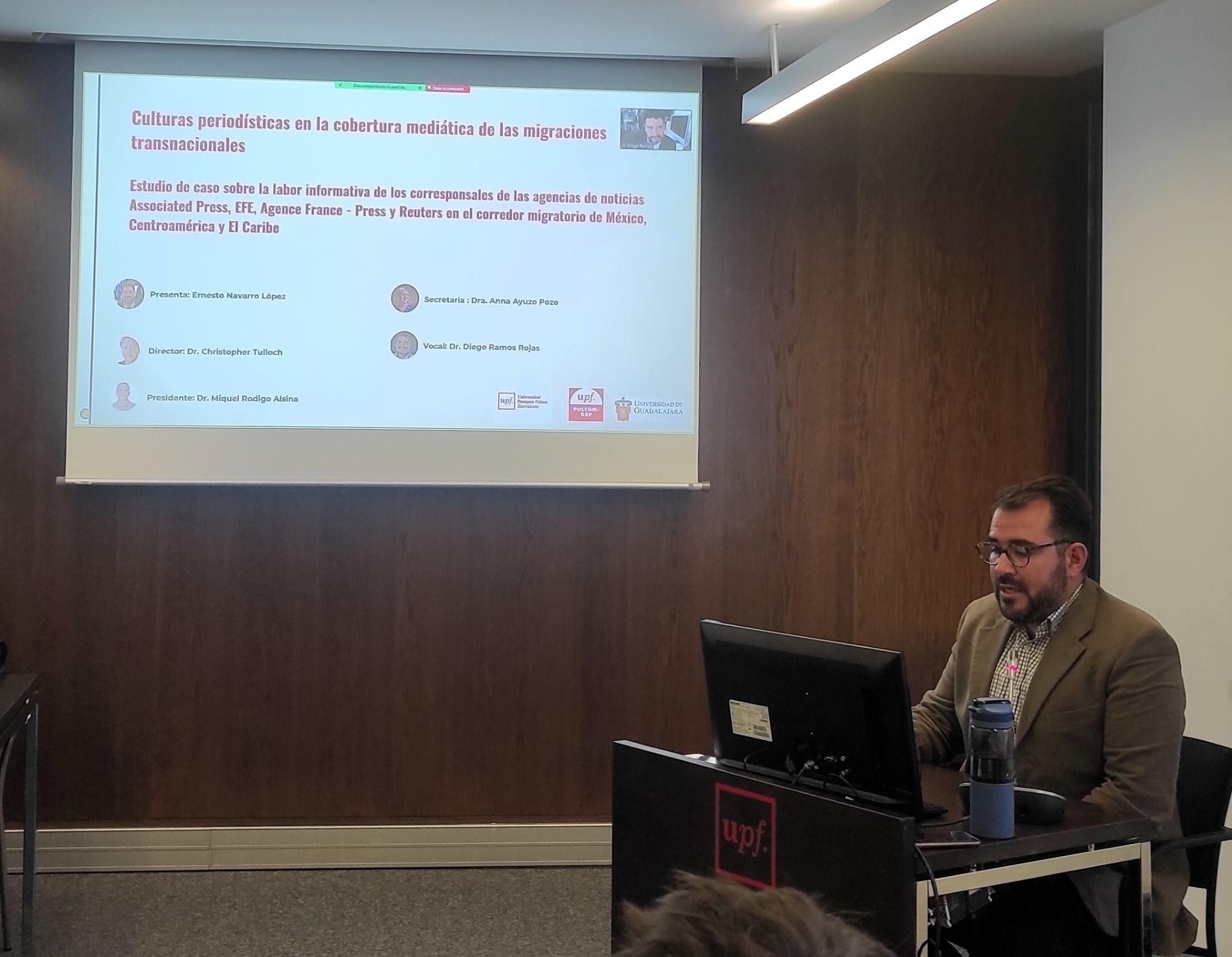
Caption: Researcher Ernesto Navarro begins the defence of his doctoral thesis at the Edifici Tànger building of Pompeu Fabra University on 11 December.
Ernesto Navarro López, a researcher with the POLCOM-GRP research group, defended his thesis entitled "Journalistic cultures in media coverage of transnational migration. A case study of the reporting work of correspondents from the Associated Press, EFE, Agence France-Press and Reuters news agencies in the migration corridor of Mexico, Central America and the Caribbean" at the Poblenou campus of Pompeu Fabra University (UPF). The research, supervised by Dr. Christopher Tulloch (UPF), was presented in monographic format.
The thesis focuses on the study of journalistic cultures, journalistic rootedness, and the different adaptation strategies being implemented by news agencies and correspondents covering migration from this region of Latin America in reporting on migratory processes.
Faced with a conjunctural crisis resulting from the increase and changes in migration flows in the region, internationally oriented media—among them news agencies—are finding themselves compelled to make internal structural adjustments in order to address a phenomenon that has become a priority issue on the transnational agenda. Consequently, these adjustments also have implications at the individual level for journalists in their professional practice.
Through an exploratory qualitative methodology, with a constructivist and systemic approach, the thesis develops three types of interviews as techniques for data production and collection: semi-structured interviews to address issues related to journalistic culture; narrative interviews (life stories) to explore questions of journalistic rootedness (who these journalists are; their experiences, values, places, stories, and shared languages with the societies in which they work). Interviews were conducted with reporters, photojournalists, news editors, and regional bureau chiefs from the four agencies studied.
Finally, the method of expert interviews was used. This was conducted with an academic with extensive experience in the study of agency correspondents and global communication, Dr. Chris Paterson from the University of Leeds, United Kingdom.
The main results reveal adjustments in the professional identity of correspondents, as well as diverse interpretations regarding what they believe societies expect from their work as journalists (institutional roles). Likewise, differences can be observed in the levels and characteristics of journalistic rootedness of correspondents within the contexts in which they operate. The concept of journalistic rootedness made it possible to observe how their experiences, backgrounds, and the diversity of contexts in which they work ultimately have implications for their professional practice.
This is particularly relevant in the context of international media (especially news agencies), as there is currently a growing trend to incorporate more local journalists into their teams. Historically, these positions have been occupied by journalists from the agencies’ countries of origin, at least in the case of the four studied: the United Kingdom, Spain, the United States, and France.
One of the most relevant concepts proposed in the thesis is that of the “strategic ritual of empathy,” which operates between journalists and migrants. It draws on the tradition of the sociology of journalism and involves dimensions of journalistic culture such as adherence to notions of objectivity and journalistic ethics. According to Navarro López, this is the result of the consolidation of migration as a media topic, migrants’ demands for political, human, and social rights, and the socialization among journalists covering the migration beat.
Another relevant aspect addressed by this thesis is that journalists are carrying out their work by drawing on other fields such as art, the mediation of emotions in communication, documentary photography, geolocation of cultural products, migration studies, among others, thereby consolidating new coverage strategies shaped through interdisciplinarity.
This was identified through the analysis of the journalistic work awarded the Pulitzer Prize (2024) by Mexican photojournalist Félix Márquez, titled Sin Ítaca que Aguarde, who collaborates freelance with the Associated Press (AP) and was among the journalists interviewed for the thesis.
This type of work, which in some way breaks with the logic of traditional journalistic production, represents an alternative method for disseminating journalistic-documentary work and pushes the normative boundaries of Western traditional journalism. Based on the study of this exhibition project, the researcher uses the concept of the cartography of migrant emotions and their visual representation to further develop this work from an interdisciplinary perspective and explore new ways of doing journalism.
Another observation is the clear configuration of the professional roles of correspondents, Navarro López notes. Current global issues require new skills in professional profiles. These have shaped the figure of the “international thematic correspondent,” to the point that it is now possible to speak of the “local and local-foreign international thematic correspondent,” as proposed by the researcher. The consolidation of this professional profile is reflected in the creation of the first thematic migration coverage team within an international agency, established by the Associated Press (AP).
This figure is based on the specialization in covering topics for distant audiences from a local perspective, with a high degree of journalistic rootedness in the territories—factors that have implications for how global-interest topics are covered and for how audiences access and cognitively interpret news.
Main conclusions
Regarding the conclusions, as part of their professional identities, correspondents assert a voice of authority in the topics in which they specialize, especially in the face of the emergence of other media figures such as content creators or influencers. They argue that their work is supported by their experience, fieldwork, interpretations of their social role, and their service role. The latter is directed both toward host societies and toward migrants themselves, as they aim to provide useful information for decision-making before or during the migration process, as well as guidance and contextualization.
According to Ernesto, this leads to diverse interpretations of professional norms, giving rise to processes of rupture and repair of the journalistic paradigm, based on tensions over what is and is not professional, ethical, or objective. At the same time, the application of new techniques or tools from fields such as art, technology, emotions, and their geo-referential dimension in cultural products is pushing the limits and boundaries of journalistic norms in response to contemporary challenges such as disinterest in global events, news fatigue, and declining trust in journalistic media.
Personal motivations of the researcher
For Ernesto Navarro, the main motivation for conducting this research was that “Mexico has historically been a country shaped by migration in its various dynamics: expulsion, transit, settlement, and return. At the end of the last decade, the phenomenon of migration gained significant social, political, and cultural relevance. I believe that national media bore a high level of responsibility in how people reacted to the increase in migration flows. In this sense, while completing my Master’s thesis, I realized that most research focused on analyzing media and journalistic practices in two strands: prestigious international media and conventional national media.”
In this regard, he identified that “there is a lack of research on news agencies in relation to migration coverage, as well as on who the journalists covering migration are. This is important given the relevance of international news agencies in the production and dissemination of information on transnational agenda issues. Moreover, the issue of migration was close to me, especially during my undergraduate studies, as I studied in a region crossed by the train known as ‘La Bestia,’ which became the main means of transportation for migrants from Central America.”
The examination committee was chaired by Dr. Miquel Rodrigo Alsina (Pompeu Fabra University), with Dr. Anna Ayuso Pozo (Autonomous University of Barcelona and Senior Researcher at CIDOB – Barcelona Centre for International Affairs) serving as Secretary, and Dr. Diego Noel Ramos Roja (University of Guadalajara, Mexico) as committee member. The latter recognized that the thesis is “an original contribution to concept development at the theoretical level, without neglecting empirical work.”
The thesis can be consulted in the UPF repository in this link.