Edgar Gómez defends his thesis on media coverage of the Syrian conflict
Edgar Gómez defends his thesis on media coverage of the Syrian conflict
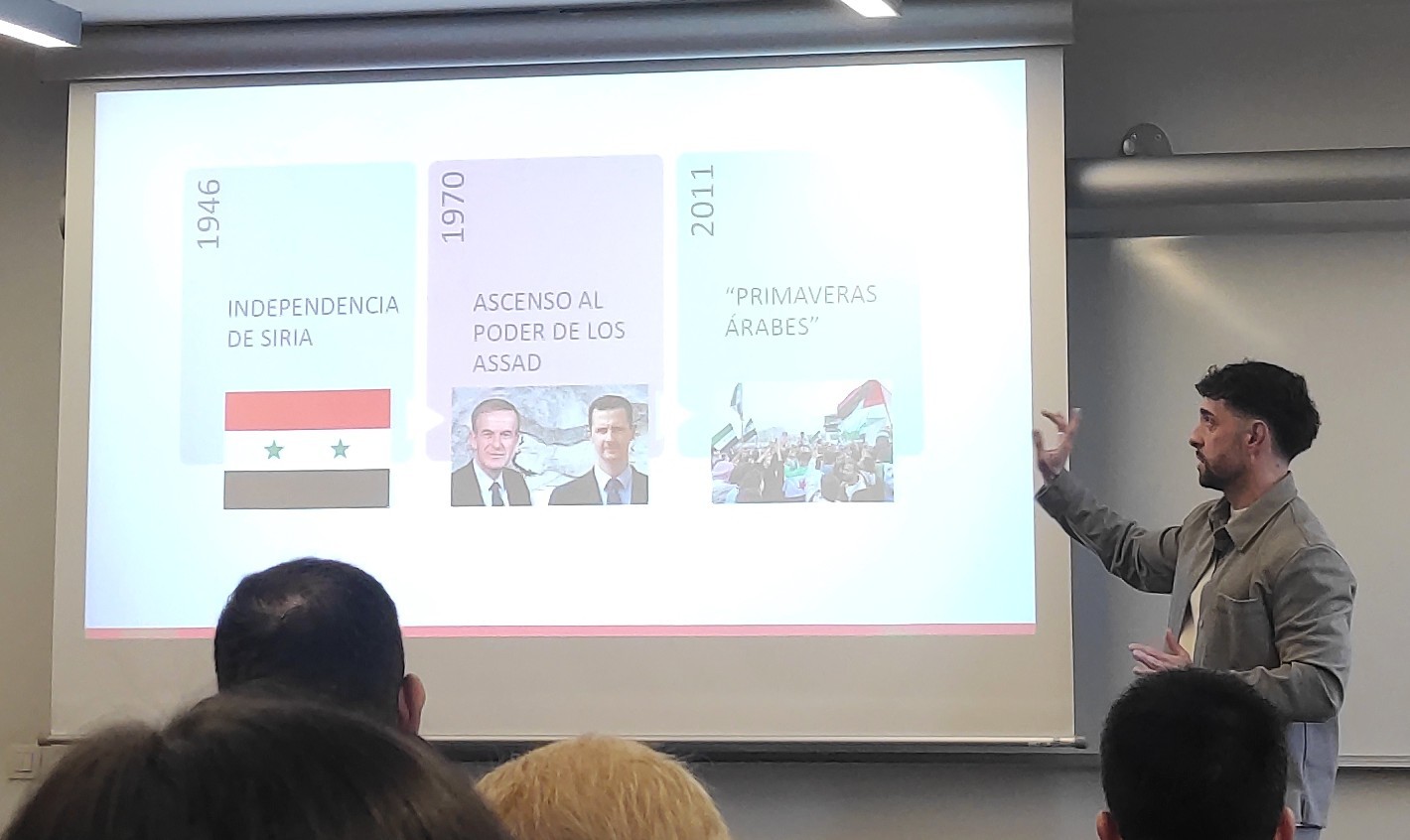
Edgar Gómez, a researcher with the POLCOM-GRP Research Group, defended his thesis entitled “International media coverage of the Syrian conflict. A critical analysis of the news production of global multimedia platforms from the perspective of peace journalism” on December 12, 2025, at the Poblenou campus of Pompeu Fabra University (UPF). The research, supervised by Dr. Christopher Tulloch (UPF) and Dr. David Meseguer, was presented in monographic format.
The research offers an analysis of the media coverage that five global multimedia platforms (Al Jazeera English, BBC, France 24 English, PBS, and RT English in their online versions) have provided of ten episodes from the first decade of the Syrian conflict (2011-2021). The study uses the methodologies of Content Analysis and Critical Discourse Analysis, in combination with the theoretical proposal of Peace Journalism. To this end, it focuses on the analysis of terminology, the representation of the main actors, and the use and treatment of information sources. The study shows that the BBC is the platform most interested in the conflict, that RT English behaves very differently from other media outlets, and that the ideology of the media can be inferred, especially from the representation of the actors and the use and treatment of sources. The thesis also reveals that Peace Journalism's viability is enhanced by its hybridization with Critical Discourse Analysis.
From his personal experience, the thesis represents for Gómez “the definitive conclusion of an academic, professional, and personal journey based on an interest and passion for a specific region, the Middle East, from a particular approach, the critical analysis of discourse in its relationship with power, and from a specific ethical perspective: the belief in a type of communication that is alternative to the dominant models.”
Based on the theory of Critical Discourse Analysis, Peace Journalism, and other trends, the research methodology consisted of analyzing 418 news items from five global platforms using Content Analysis (quantitative) and Critical Discourse Analysis (qualitative).
Among the main results, AL JAZEERA English uses Peace Journalism in 21.4% of its sample, below the overall average (25%). Its ideology, leaning towards opposition actors with particular relevance in internal conflicts, can be inferred, especially from the qualitative priority given to sources, a subtlety typical of a media outlet that acts as soft power. Secondly, the BBC uses Peace Journalism in 27.4% of its coverage, above the overall average (25%); its ideology can be inferred from the qualitative priority given to sources, tending towards the positions of actors in favor of the opposition, with special emphasis on international states that fulfill this characteristic, a delicacy that confirms its role as soft power. Thirdly, FRANCE 24 English applies Peace Journalism in 22.5% of its pieces; its position on the conflict, leaning mainly towards the internal opposition, can be inferred from the aforementioned imbalances and the qualitative priority given to sources. It acts as soft power, but not as subtly as the two previous media outlets. Fourthly, PBS uses Peace Journalism in 20.3% of its pieces, below the total average (25%). Its position on the Syrian conflict, leaning towards the international opposition, can be inferred from the imbalance in the use of sources, the disproportionate mention of foreign actors, and the qualitative priority given to sources. It acts as soft power in the style of the previous media outlet. Finally, RT English uses Peace Journalism in 28.6% of its articles, above the total sample average (25%), making it the media outlet that uses this theory the most. Its ideology regarding the Syrian crisis, inclined towards internal and external positions in favor of the Syrian government, can be inferred from the designations, use, and disuse of internal sources, the disproportionate mention of internal actors, and the role given to Russia. It is the media outlet that acts least as soft power among those analyzed here.
With regard to the conclusions of the thesis, the media coverage of the five platforms is affected by the Syrian media context and the geopolitical position of the states that finance them. On the other hand, there is no uniformity, either quantitative or qualitative, in the coverage that the three Western media outlets in the sample have given to the first decade of the Syrian conflict. RT English shows very different informational behavior compared to the other media outlets. Al Jazeera English is original in its quantitative treatment of regional issues, but not in its qualitative treatment of them. Twenty-five percent of the articles analyzed reproduce some of the precepts of traditional Peace Journalism. Finally, the analysis of the sample, based on a combination of the quantitative method and the hybridization between Peace Journalism and Critical Discourse Analysis, has made it possible to generate more and better probabilities of applying Peace Journalism by better highlighting the cracks in which it is found.
The panel was chaired by Dr. Ignacio Álvarez-Ossorio Alvariño (UCM) and also included Dr. Cristina Perales García (UPF) as Secretary and Dr. Jose Luis Gordillo Ferre (UB) as Member. They praised the thesis's “clear structure” and “methodological robustness,” as well as other aspects such as the “gender sensitivity” of the selection of sources for the theoretical framework. He also highlighted how the discipline of peace journalism is “practicable, but at the same time challenging.”