Department | Faculty of Communication
Lynn Caroline Bröker defends her thesis on cultural diversity and algorithmic display of content in the context of the Audiovisual Media Services Directive
Lynn Caroline Bröker defends her thesis on cultural diversity and algorithmic display of content in the context of the Audiovisual Media Services Directive
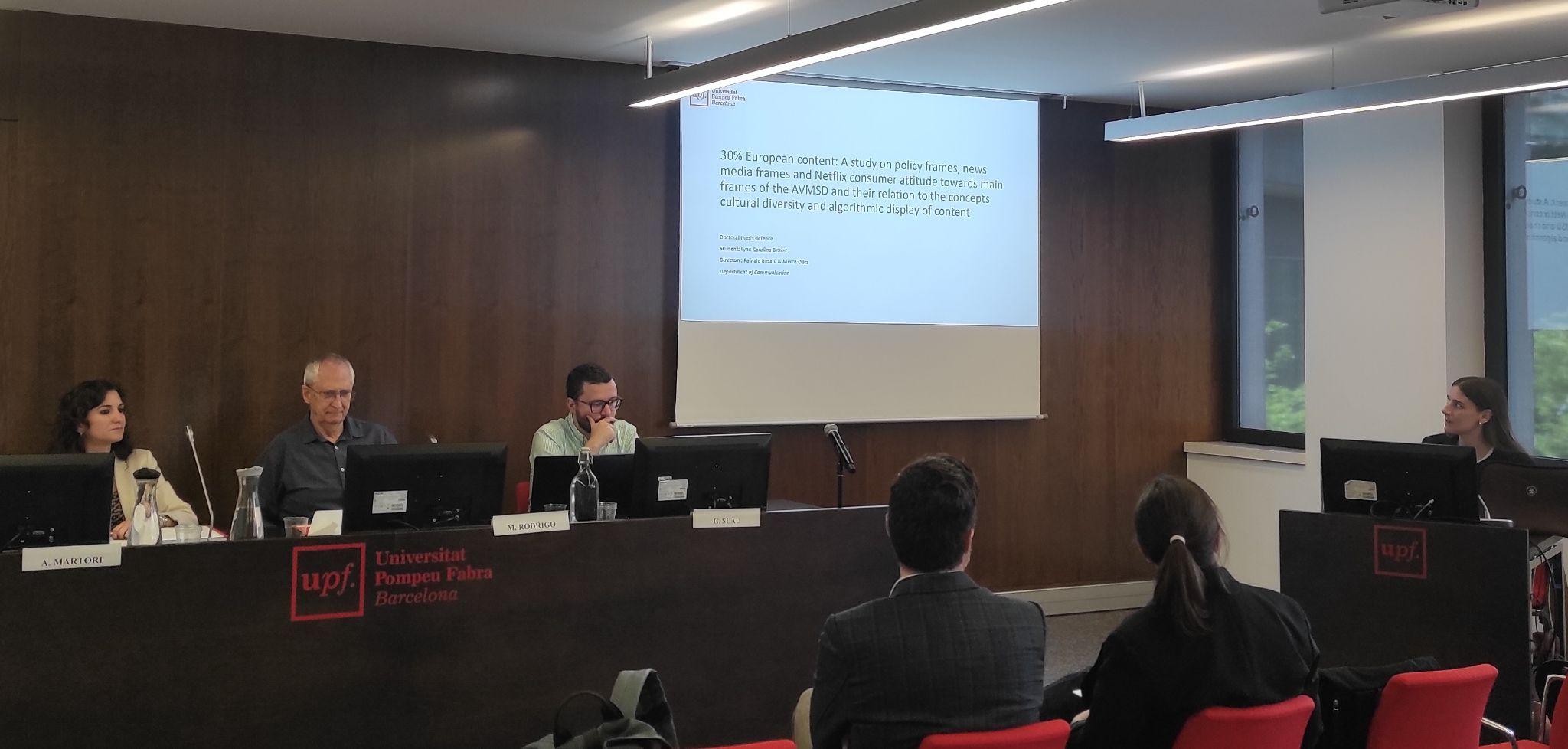
Lynn Caroline Bröker, a researcher with the POLCOM-GRP research group, defended her thesis entitled ‘30% European content: A study on policy frames, news media frames and Netflix consumer attitude towards main frames of the AVMSD and their relation to the concepts cultural diversity and algorithmic display of content’ on 7 May 2026 at the Poblenou campus of Pompeu Fabra University (UPF). The research, supervised by Dr. Reinald Besalú (UPF) and Dra. Mercè Oliva (UPF), was presented in monographic format.
The doctoral thesis follows a sociotechnical approach to the analysis of cultural diversity and
algorithmic content display in the context of the Audiovisual Media Services Directive (AVMSD). A main objective of the AVMSD is to promote and protect the audiovisual sector and cultural diversity with specific policy measures, such as the 30 % quota for European content, and the requirement for prominence and investments. Methodological approaches include a systematic frame analysis of policy documents and news articles from France, Germany and Spain, as well as a questionnaire distributed to European Netflix users. The findings encompass the location of 10 dominant frame packages. They also reveal why algorithmic content display cannot be conceptually disconnected from the cultural diversity objective, as it is omnipresent in the process of digital content curation and consumption. Ultimately, the findings highlight that both concepts are not sufficiently operationalised at the policy level, which leads to specific issues and vulnerabilities.
The researcher has more than 15 years of experience working in Marketing and Communications and is aware that most of our everyday lives and interactions have become mediated experiences, shaped by algorithmic systems. Her thesis topic combines two aspects, media and culture, that have shaped her personally. During childhood, she earned her first income on a film set and moved from Germany to the Central American Caribbean.
The Methodological approaches include a systematic frame analysis of policy documents and news articles from France, Germany and Spain, as well as a questionnaire distributed to European Netflix users.
The findings encompass the location of 10 dominant frame packages. They also reveal why algorithmic content display cannot be conceptually disconnected from the cultural diversity objective, as it is omnipresent in the process of digital content curation and consumption. Ultimately, the findings highlight that both concepts are not sufficiently operationalised at the policy level, which leads to specific issues and vulnerabilities.
Her data results demonstrated a trigger down effect of frames from the policy to the news level, while the data also indicated that the lack of operationalisation at the policy level facilitated additional fragmentation of frames at the news level.
Cultural diversity, an intrinsically social objective, is commodified and reduced to a secondary by-product of the objective to foster and protect the European audiovisual sector.
The absence of a concrete operationalisation of the concept and the absence of explicit policy measures have facilitated the commodification of cultural diversity.
Findings reveal why algorithmic content display cannot be conceptually disconnected from the cultural diversity objective, as it is omnipresent in the process of digital content curation and consumption. Algorithmic systems were not operationalised or addressed through concrete policy measures within the AVMSD. And while algorithms or AI may generally be trending and salient news topics, journalists were not contesting algorithmic or digital narrative in relation to the AVMSD within the examined corpus of news articles.
Lynn introduces a revised framework of cultural diversity, incorporating Napoli’s framework of cultural diversity (1999) and the concept of algorithmic content display. She also proposes new industry quality frameworks.
The panel was chaired by Dr. Miquel Rodrigo Alsina (UPF) and also included Dr. Guillem Suau Gomila (Universitat de Lleida) as secretary and Dra. Aida Martori Muntsant (Universitat Autònoma de Barcelona) as a member.