Department | Faculty of Communication
Cristhian Lozano Recalde defends his thesis on the use of social media in crisis communication in Ecuador
Cristhian Lozano Recalde defends his thesis on the use of social media in crisis communication in Ecuador
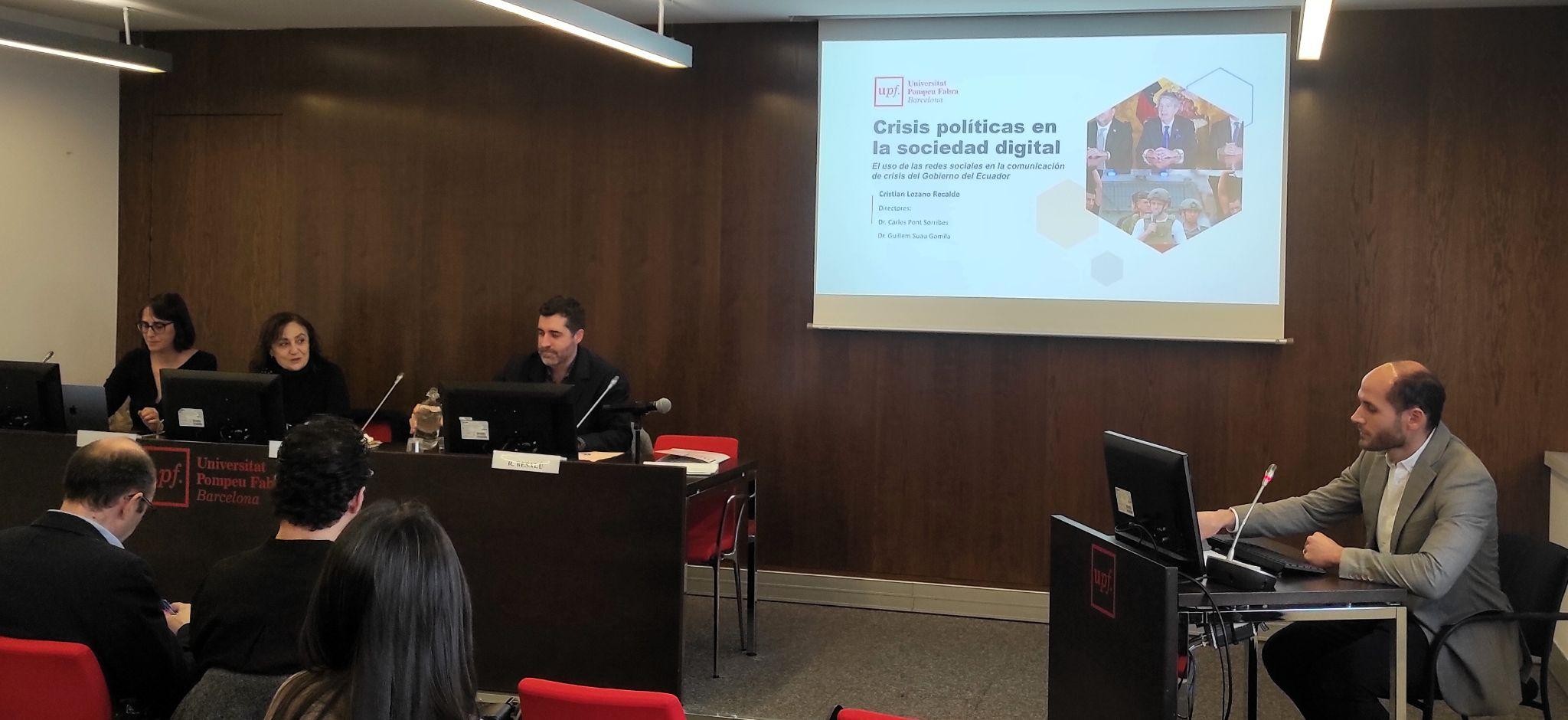
Cristhian Lozano, from the POLCOM-GRP research group, defended his thesis entitled "Political crises in the digital society. The use of social media in crisis communication by the Ecuadorian government" on 27 February 2026 at the Poblenou campus of Pompeu Fabra University (UPF). The research, supervised by Dr Carles Pont (UPF) and Dr Guillem Suau (UdL), was presented in compendium format.
In the digital society, technologies shape a large part of social structures and blur the boundaries between the physical and the digital. In this scenario, social media play a central role in communication processes, information consumption and citizen participation. This research examines the use of social media in government crisis communication, taking the experience of the Ecuadorian government as a case study. Based on triangulation between document review, first-hand observation of crisis management on social media and the opinions of professionals, a comprehensive view of the phenomenon studied was obtained. The findings show that social media is essential for achieving an accurate reading of the crisis, responding immediately to events, leading the flow of information, and seeking support for the official narrative. Likewise, the specific potential of each platform and the incorporation of visual content to adapt messages to the most effective format and language in each case is evident.
Regarding his professional motivations for writing the thesis, Lozano highlights: "to obtain training as a researcher to strengthen my profile as a communications professional. I like research and saw the doctorate as a way to strengthen my theoretical foundations and incorporate new tools that could be useful in the professional field. I was interested in exploring the possibility of combining professional and academic activities. On the selection of the topic: "I had chosen public crisis communication as the area in which I wanted to specialise. I believe that this branch is where communication is most valuable because it is designed to benefit citizens in complicated situations, with a high degree of uncertainty and where there are vital threats. After an initial exploration of the academic literature, I finally chose to analyse political crises because I saw an opportunity in the sense that government crisis communication is not professionalised. Furthermore, there is not enough awareness that poor crisis communication not only jeopardises the stability of governments and rulers, but also weakens institutions and delegitimises democracy."
The methodology applied consisted of a scoping review, content analysis on social media, and in-depth interviews. To conduct the study, a mixed methodology was applied that combined three approaches: a scoping review of the academic literature; content analysis on X, Instagram, and TikTok; and in-depth interviews with communication managers from previous administrations. As case studies, government communication on social media during the 2022 National Strike and the 2024 Internal Armed Conflict were analysed.
Regarding the main results of the research, research on public crisis communication has grown significantly in the last 10 to 15 years, but in an unbalanced way. There is a lot of literature on communication in disasters and health emergencies, but little focused on political crises. In fact, the term ‘political crisis’ as such is still vague and polysemic. On the other hand, when analysing the use of social media in crisis communication, Twitter (X) and Facebook are usually investigated. In recent years, other platforms have begun to be investigated, but perhaps not enough. In addition, there is little analysis of the use of images in crisis communication. This is important because the current dynamics of social media are almost entirely focused on the video format. Finally, even government communication professionals do not entirely agree on what a political crisis is. In practice, management is mainly based on the professional's research, experience and intuition. However, there are no systematised processes or guidance documentation for dealing with crises. It is a reactive, not a proactive, practice. Crises in governments are inevitable, although there are practices that can prevent them or allow them to be better prepared for. Some of these practices are directly linked to the use of social media, which is currently the main channel for communicating crises. To give a few examples: daily monitoring of issues that could become crises and analysis of what is being said about them; responding immediately and frequently; expanding the reach to different social media platforms, adapting the message to each space; using images to reinforce information, generate empathy and strengthen political leadership.
As a main theoretical and practical contribution, a decalogue of recommended practices for improving government crisis communication through the use of social media is presented. This guide summarises the lessons learned and is intended both as a practical tool for public managers and as a starting point for future research on government communication in crisis contexts.
The evaluation panel was chaired by Dra. María Luisa Sánchez Calero (UCM) and also included Dr. Reinald Besalú Casademont (UPF) as secretary and Dra. Joana Soto Merola (UdL) as member.