
3/06/2025 - DemoSoc Seminar: Convergence in the NEET rates across the European Union: do gender differences persist?
3/06/2025 - DemoSoc Seminar: Convergence in the NEET rates across the European Union: do gender differences persist?
3/06/2025 - DemoSoc Seminar: Convergence in the NEET rates across the European Union: do gender differences persist?
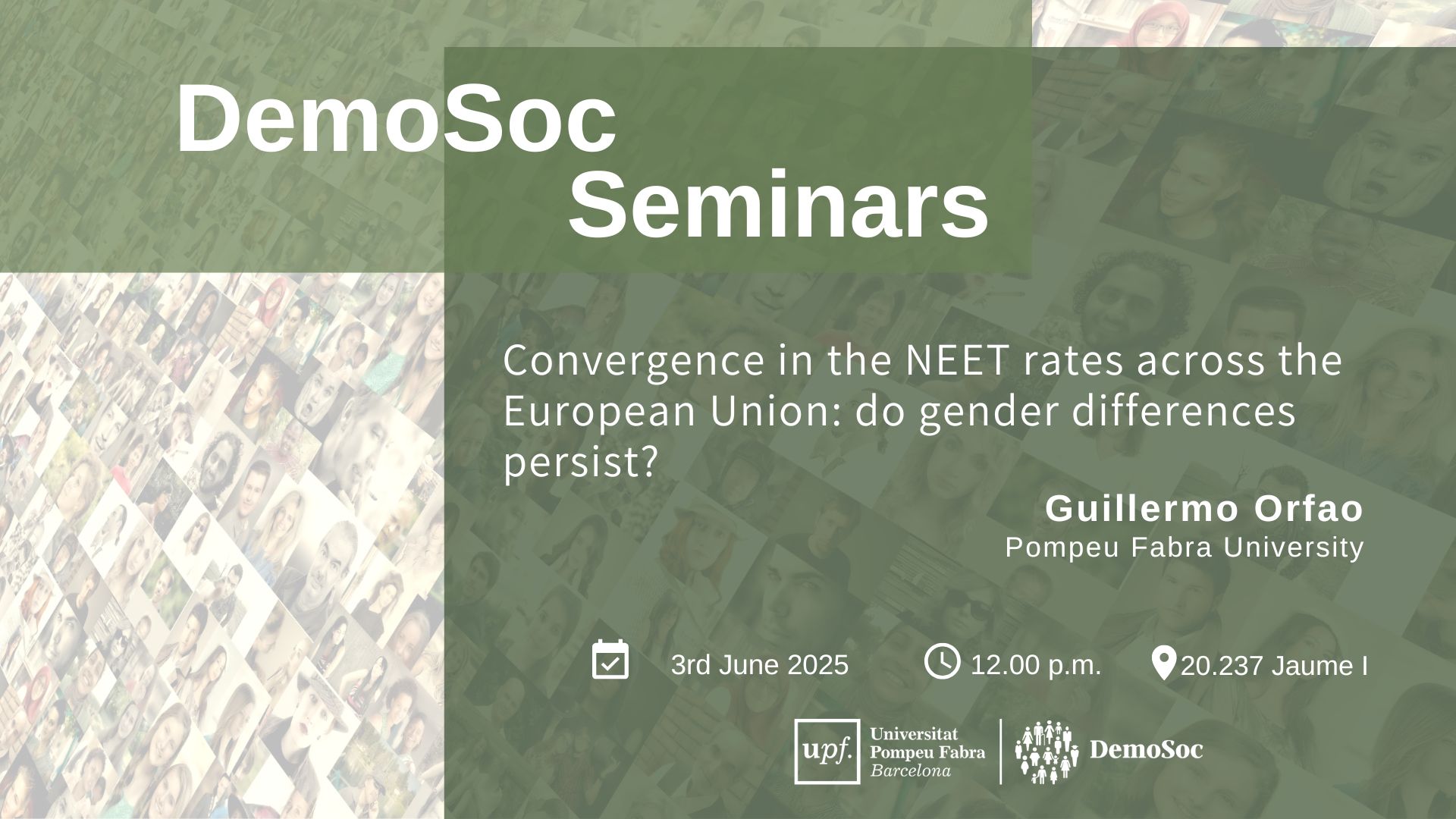
The DemoSoc seminars at Universitat Pompeu Fabra aims to gather all researchers at UPF and beyond working on the fields of demography and sociology (social stratification).
The next DemoSoc Seminar of this course will take place on:
June, 3rd
12.00 h
20.237 (Jaume I)
Convergence in the NEET rates across the European Union: do gender differences persist?
Guillermo Orfao, Pompeu Fabra University will be in charge of leading the session.
Abstract: This work explores the patterns of convergence by gender of young people Not in Employment, Education, or Training (NEET) across EU-27 countries from 2004 to 2022. We apply the beta, sigma, and delta convergence methodology using data from the EU Labor Force Survey and Eurostat. Our findings suggest a reduction of gender disparities in the NEET rates across countries, with a decline in the average gender gap (upward β-convergence). Although there is no reduction in the overall dispersion among countries (no σ-convergence), we found evidence of a catch-up process towards the countries with the smallest NEET rate gender gaps (delta-convergence). Gender convergence is guided by improvements in women's labour market and education outcomes, alongside a general deterioration in men's conditions. Moreover, early school leaving, youth employment rates and expenditure on active labour market policies affect convergence by gender in the long run. We discuss the policy implications of our findings.
Brief biography: Guillermo Orfao holds a degree in Economics and a PhD in Applied Economics from the University of Salamanca (USAL). He is currently a Juan de la Cierva research fellow in the Department of Political and Social Sciences at Pompeu Fabra University (UPF). He has undertaken various research stays at international institutions, including Eurofound, the Joint Research Centre of the European Commission, and the University of Bari Aldo Moro. He currently leads a research project entitled “Employment and Working Conditions of the Most Vulnerable Workers: Addressing an Ongoing Policy Challenge,” funded by Eurofound. His research focuses on labour market dynamics in the European Union, with a particular emphasis on youth, precarious employment, and non-standard forms of employment, and he has published in several international academic journals.