
ComCiRed 2026 arrived in Salamanca and placed the spotlight on social knowledge transfer
ComCiRed 2026 arrived in Salamanca and placed the spotlight on social knowledge transfer
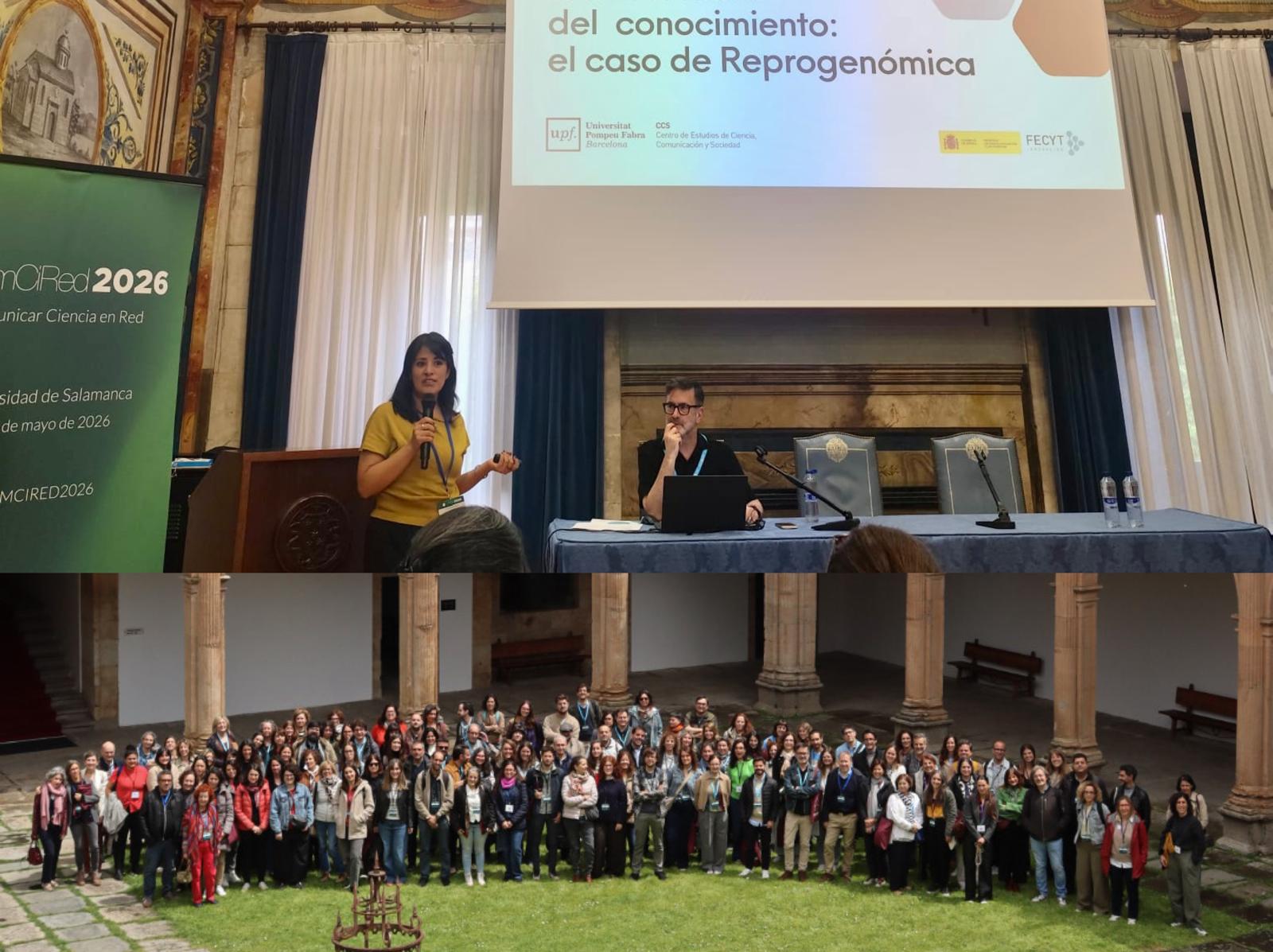
On 7 and 8 May, the University of Salamanca hosted a new edition of ComCiRed 2026, the annual meeting of the Scientific Culture and Innovation Units (UCC+I). Professionals in science communication from across the country attended the event to share experiences, present projects and reflect on the current challenges of public science communication.
During the meeting, workshops were held focusing on key topics such as citizen participation, innovation in digital formats, gender perspectives and inclusive communication strategies. Scientific outreach projects and good practices developed by various UCC+I throughout 2025 were also presented.
In this context, Paulina Brena, from the Science, Communication and Society Studies Centre (CCS‑UPF), delivered the talk “Social Knowledge Transfer: the Reprogenómica Case”. Her contribution highlighted how social knowledge transfer has taken on a central role in recognising the impact of science beyond academia and beyond traditional indicators, which do not always reflect its social value.
From this perspective, social knowledge transfer is understood as the process through which scientific knowledge is translated into tangible changes in people’s lives, in the design of public policies and in the strengthening of democratic culture. In this process, public science communication is positioned as a key tool, supported by a framework of seven pillars: defining objectives, strategy, skills development, resources, institutional support, collaboration among stakeholders and impact evaluation.
As an example of this approach, the Reprogenómica project was presented, focusing on public perceptions of genetics and genomics in the field of human reproduction. Using qualitative methodologies such as discussion groups and surveys, the project analyses expectations, doubts and concerns surrounding these technologies, incorporating a gender perspective to understand their impact on decision‑making.
This project not only seeks to generate recommendations for communication in this field, but also, following the logic of social knowledge transfer, to connect its findings with relevant organisations in order to help generate tangible change.
In this way, ComCiRed 2026 reinforces the role of UCC+I as key spaces for connecting science and society.