
Phonos
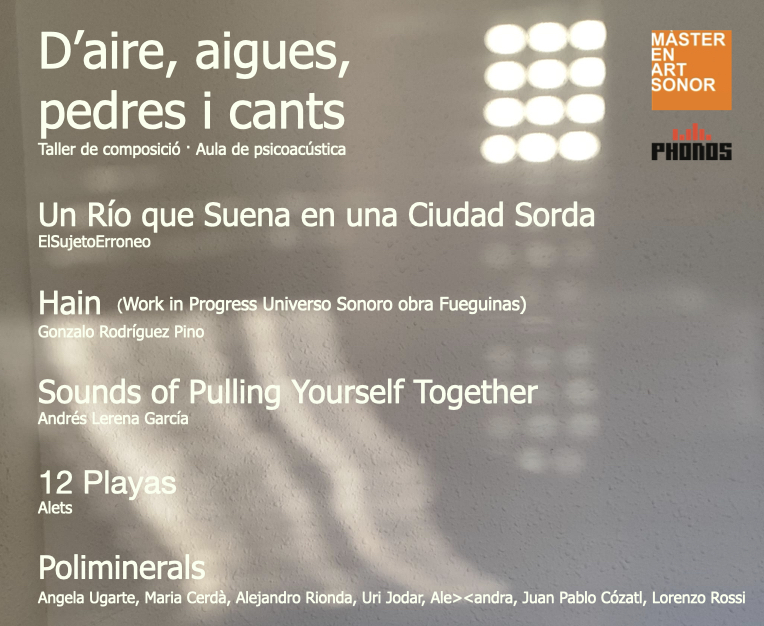
On Air, Waters, Stones and Songs
On Air, Waters, Stones and Songs
Master in Sound Art · University of Barcelona
Composition workshop of the psychoacoustics studio
Program:
- El Río que Suena en una Ciudad Sorda - ElSujetoErroneo
- Hain (Work in Progress Universo Sonoro obra Fueguinas) - Gonzalo Rodríguez Pino
- Sounds of Pulling Yourself Together - Andrés Lerena García
- 12 Playas - Alets
- Poliminerals - Angela Ugarte, Maria Cerdà, Alejandro Rionda, Uri Jodar, Ale><andra, Juan Pablo Cózatl, Lorenzo Rossi
Josep Manuel Berenguer (director)
The composition workshop of the psychoacoustics studio from the Master’s in Sound Art at the University of Barcelona presents Of Air, Waters, Stones and Songs: sonic reflections that reveal themselves in their most intimate vibrations. The concert traverses auditory forms that evoke primal elements —where listening becomes living matter— but also recent human actions, aggressive and conflictive in nature.
Of Air, Waters, Stones and Songs is an acousmatic immersion where sound unfolds without the physical presence of performers, beyond the spatial diffusion control that turns loudspeakers into instruments, space into their resonance box, and each listener into an inhabitant of a fluctuating world in which they are immersed from the very first moment. Moving air, flowing water, the weight of stone, and the memory of song come together in textures, gestures, and tensions that can only be perceived when we turn our gaze backward.
These sounds come from the world itself and from its transformation, but they are not instrumental. They are sounds from a world in conflict, made evident through the air that brushes, the water that draws forms in motion, the stone that resonates when passed, and the ancestral song that runs through them all.
Air, in its subtlety, carries sighs, turbulence, and breath that shape space. Wind, as the active form of air, becomes sonic matter through its friction with branches, rooftops, cracks, and also through the bodies of objects turned into aeolian instruments. It is the sound of impermanence.
Water sings with its own varied voice: rhythmic dripping, murmuring streams, crashing waves, or subterranean currents that strike. It flows and transforms continuously, like the time that inhabits it, while often also becoming a site of borders, dissolution, discrimination, and conflict.
Stone, seemingly inert, holds deep resonances: the echo of a blow, the scrape of a foot, the dry sound of a landslide. It is the mineral memory of the landscape, resilient and ancient, capable of becoming timbre, pulse, or heavy silence. But not only that: its form, structure, and composition —which determine the possibility of the sounds it emits— are also symptoms of climate and social transformations. Political ones, too.
Ancestral songs, in contrast, speak to us of presence. They are traces of life that emerge: the human voice in both its fragility and its strength; the cry of a distant bird; a vocal mark floating over abstract textures. Song is trace and invocation. To inhabit is to leave traces —sonic and verbal alike.
The composition workshop of the psychoacoustics studio is made up of Alets Barranco, Alexandra Bellini, Maria Cerdà, Juan Pablo González, Oriol Jodar, Andrés Lerena, Jorge Alejandro Rionda, Gonzalo Rodríguez, Lorenzo Rossi, Jesús Orlando Torres, and Ángela María Ugarte.
In collaboration with:
Supported by:
