
Investigative journalism and ChatGPT: using generative AI for sourcing and story research
Investigative journalism and ChatGPT: using generative AI for sourcing and story research
By the OCM team
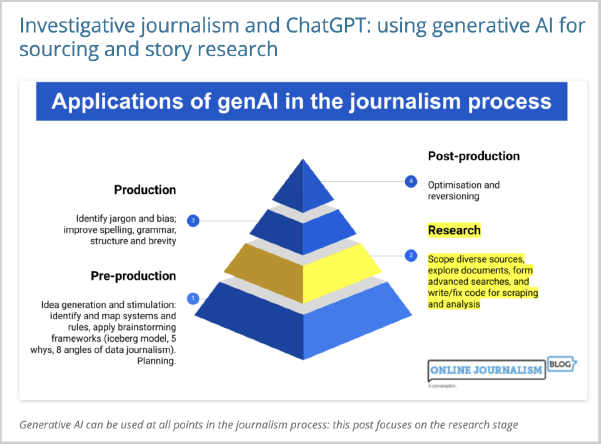
In recent years, investigative journalism has begun to explore the use of generative artificial intelligence as a tool for research and source gathering. While this technology offers immense potential, it also presents certain risks that professionals must consider, such as the possibility of generating false information or "hallucinations," as well as working with biased data.
Despite these challenges, AI can be highly useful in the early stages of an investigation, such as idea generation or gathering preliminary information, as long as it is used with the proper precautions.
As mentioned in the Online Journalism Blog, research is the second most risky area (after content creation) for the use of generative AI in journalism. One of the most evident risks is AI’s ability to "invent" facts, but there are other factors to consider.
For example, tools like ChatGPT are trained only with data up to a specific date, known as their "knowledge cutoff." While this can be partially addressed through techniques like retrieval-augmented generation for real-time data, it remains a challenge.
Additionally, the quality of the data used to train these models varies, and there may not be enough quality control to ensure that algorithms distinguish between facts, speculation, or satire. Nevertheless, there are advances in this area, such as custom GPTs (e.g., Factiverse), that aim to address these concerns.
It is crucial for journalists to understand both the advantages and risks of this technology to integrate it effectively into their investigations without compromising the accuracy or integrity of their work.
If you are interested in learning more about how AI is transforming journalism and best practices for using these tools, I invite you to continue exploring this topic.
(...)