“Universities must be prepared to make their programmes flexible and allow a degree of customization by the student”

Contra el genocidi i contra la violació dels drets humans, a Gaza i arreu del món

Peace comes when you talk to the person you most hate. And that’s where the courage of a leader comes.
Desmond Tutu (1931-2021), first recipient of an honorary doctorate from UPF
These words, spoken by Desmond Tutu, the first person ever to be awarded an honorary doctorate by UPF, are more applicable today than ever. The UPF condemns, and will always condemn, the use of violence to settle disputes. At UPF, we advocate approaching political or territorial conflicts based on dialogue and respect for all peoples and minorities.
As a university, we also want to show our support to the academic community in countries at war. Universities and scientific institutions are more necessary than ever in these regions. Access to education and the promotion of critical thinking, in the context of strong independent institutions, are the way to ensure the informed debate and reflection that can open the door to new avenues for finding solutions.
At UPF, we are aware of the university community’s concern for the human rights violations we are seeing in the conflicts around us. That is why on this website you will find information about campaigns and actions related to current conflicts, as well as opinion pieces and institutional statements. We also offer a dedicated e-mail address – [email protected] – to contact the university and let us know about your interests and concerns.
“Universities must be prepared to make their programmes flexible and allow a degree of customization by the student”
“Universities must be prepared to make their programmes flexible and allow a degree of customization by the student”
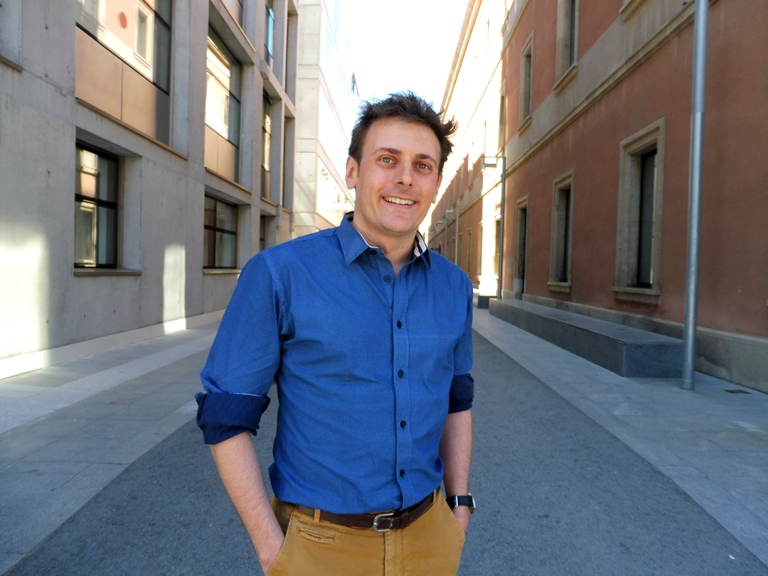
We are talking to Manel Jiménez, professor with the Department of Communication and academic director of the Center for Innovation in Learning and Knowledge at UPF, on the occasion of World Creativity and Innovation Day (21 April).
Today, 21 April, is World Creativity and Innovation Day and so we wanted to talk to Manel Jiménez, professor with the Department of Communication and academic director of the Center for Innovation in Learning and Knowledge (CLIK) at UPF, which works in a multi- and cross-disciplinary way to inspire and motivate teachers in their teaching.
- When we talk about innovation in teaching, what do we mean? Does it involve implementing technology in learning or is it rather a broad concept that touches on many different themes?
The term innovation is difficult to define, not only because of its multiple meanings, but also the difficulty in finding parameters that can measure it. This is so for teaching, but also in relation to research and management. In my opinion and generally, when we talk about innovation in teaching we refer to the actions and processes that facilitate a prosperous change in the practice of educating. To my understanding, innovation should not be a goal in itself when articulating teaching.
- What are the main challenges universities are facing regarding innovation?
The university is an institution that has been popularly characterized by its inflexibility in respect of its structures and operational dynamics. The democratization of the access to knowledge, among other factors, has reversed the understanding of teaching and this means we must also be innovative in how we conceive it. Among the innovation challenges we could highlight: consideration of the student not only at the centre of the learning process, but also right at the heart of the co-creation of knowledge; review of classroom presence and the teaching spaces; the changing role of the teacher as a support for knowledge acquisition; the inversion of the activities carried out in the classroom and at home.
- What is the current status of UPF? The initial diagnosis places us in a good starting point?
Several indicators have positioned Pompeu Fabra as a university of excellence from the point of view of teaching. A well positioned university regarding teaching is generally a university that seeks to achieve a steady improvement in its teaching and learning methods. In recent years, UPF has come onto the international scene due to several innovative actions, the merit of which is essentially its teachers’. By launching certain educational innovation calls, such as the PlaCLIK or the VEU Project and also the Board of Trustees awards, many lecturers have helped put the University on the map of teaching innovation.
- How must teachers and students adapt to all of that?
The first who have to adapt to this transformation are the lecturers. We have to understand that our role should change in some respects. Moreover, the symbiosis between teaching and research activities is seen as absolutely necessary: the processes and outcomes of research require intervening in the classroom, better connecting what is being explored with what is being taught. And, conversely, research can also absorb the progress made by the students in the classroom and the role of the student as a co-creator.
The students, in turn, are now demanding change. We can see it in their daily behaviour.
- And the university as an institution?
In recent years, we have read and heard several appraisals that speak of the end of the university as an institution of knowledge and that at some time in the future only a few universities will survive. The universities must find their uniqueness. And they must allow their students also to be unique. Universities must be prepared to make their programmes flexible and allow a degree of customization by the student to cross disciplines and to project the professions of the future.
- What we are saying is that in about 5-10 years’ time education as we know it now will be completely different?
We are talking not only about the need for change, but current participation in the transformation. We are building the teaching of ten years’ time now, because society is changing now. Our students are different, obviously, but the lecturers have also adopted different habits. The administrative circuits also require this transformation and the administrative and services staff are a part of this change. If, as I said, in the past the university was an institution that was hardly open to change, we are now at a time of an implosion of knowledge. Evolution is inevitable.
- At UPF we have a specific centre dedicated to this area, the CLIK. What are its goals?
The CLIK is a centre designed to promote teaching at UPF, an area offering support for teachers which aims to improve our teaching and learning processes. In brief, we undertake the professional development of teachers and doctoral students through training courses. We work in teaching innovation from different angles: the creation of a genuine model for UPF, the development of new learning formats, the tools, resources and methodologies that can be used in the Aula Global, social responsibility, tutorship programmes, etc. At the same time, we deal with all of the University’s multilingualism policy. For those who do not know the CLIK you can go on this “journey to the centre of knowledge” via a new, far more intuitive and user-friendly website.
- Do similar centres exist at other universities? Are we adapting to the changes at the right speed?
Indeed, there are innovation centres elsewhere. The CLIK is connected with many international innovation centres through various networks and, throughout this past year, has been host to several workshops and conferences. Concerning speed, we have to control our own pace according to our goals and our way of being. In fact, in many cases, we are ahead of many universities... even though I shouldn’t say so!
Related Assets

Catalan government
Catalan development cooperation aims to help prevent and respond to emergency situations. This page explains how you can collaborate on the provision of foreign aid both in general and to specific regions.

European Commission
Through cooperation and assistance programmes, the European Commission offers humanitarian aid and coordinates efforts with other international actors to promote peace and stability in war-torn regions.
Oxfam Intermón
Oxfam Intermón works in 90 countries. They have launched a fundraising campaign, which is more necessary than ever, given the magnitude of today’s wars. The NGO is also sponsoring a campaign to collect signatures to call for a ceasefire in Gaza.

Doctors Without Borders (MSF) is a medical-humanitarian action organization that provides assistance in 70 countries to people threatened by armed conflicts, violence, epidemics or neglected diseases, natural disasters and exclusion from medical care. They have also promoted a campaign to collect signatures to ask for a ceasefire in Gaza.
Red Cross
The Red Cross also provides emergency humanitarian aid in regions in crisis.

Legal Clinic
The UPF Legal Clinic regularly holds talks and roundtables on the protection of human rights in crisis regions.
Libraries Without Borders
The Libraries Without Borders programme, sponsored by the Catalan Development Cooperation Agency (ACCD), offers Catalan public library patrons knowledge and insight into situations of human rights violations and provides resources to take action.
Council for At-Risk Academics
The Council for At-Risk Academics, in partnership with universities and higher education institutions, provides urgently-needed help to academics in immediate danger, those forced into exile, and many who choose to work on in their home countries despite serious risks.